The share of the US population age 65 and older is rising dramatically. In the year 2000, 12 percent of the population was over age 65; by 2050 that share will be 22 percent. Much of that aging has already occurred: in 2022, just over 17 percent of Americans are retirement age. Population aging is applying upward pressure on government deficits as a result of increased public spending on programs, including Social Security and Medicare, that are designed to support older Americans. I argue that broader distributional measures assessing who pays for and who benefits from age-related government programs, both across and within generations, are necessary to inform policy decisions. However, in addition to direct aging-related government expenditures, I argue that unfunded spending in other, non-aging parts of the budget along with recent tax policy changes portend significant intergenerational redistribution. These distributional impacts should be measured and taken into account by lawmakers who seek to address looming fiscal challenges in a more equitable way.
Suggested Citation: Sabelhaus, John. December 10, 2022. “Will Population Aging Push Us over a Fiscal Cliff?” In Economic Policy in a More Uncertain World, edited by Melissa S. Kearney and Amy Ganz. Washington, DC: Aspen Institute. https://doi.org/10.5281/zenodo.14026862.
The US economy has been suffering from weak productivity growth, business dynamism, and competition for the past several decades. The loss of a vibrant economy is even more concerning as the economy faces new challenges such as the transition to green energy that call for novel technological advancements. Reduced technological diffusion in the economy has been impairing the competitive environment favoring established market leaders, with patents and inventors being hoarded by these firms, hampering overall innovativeness and dynamism of the economy. We argue that policies to alleviate these concerns and enhance competition can boost overall innovativeness of the economy. Reducing barriers to foreign competition is an effective option to achieve this goal. Similarly, tapping into global talent is a viable policy to improve the level of human capital.
Suggested Citation: Akcigit, Ufuk and Sina T. Ates. December 10, 2022. “New Insights for Innovation Policy” In Economic Policy in a More Uncertain World, edited by Melissa S. Kearney and Amy Ganz. Washington, DC: Aspen Institute. https://doi.org/10.5281/zenodo.14026870.
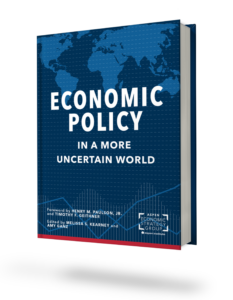
The Aspen Economic Strategy Group’s Annual Policy Volume Economic Policy in a More Uncertain World marks the group’s 5th anniversary and is released against a backdrop historic economic and strategic uncertainty. The book’s seven chapters, each written by leading experts and edited by AESG Director Melissa S. Kearney and Deputy Director Amy Ganz, provide a deep-dive on long-term economic headwinds confronting the country, including demographic changes—declining fertility and population aging—and what a smaller worker to population ratio means in terms of slower economic growth, reduced revenue, and lower productivity growth. Additional chapters on the US immigration system and US innovation policy highlight potential solutions for countering these trends. Another chapter explores potential adverse impacts on local labor markets from the green energy transition and highlights policies to avoid repeating painful mistakes of the past, including the response to the decline of the coal industry and rise of globalization and automation. A final chapter highlights lessons learned from the unprecedented federal aid to state and local governments during the COVID-19 pandemic.
AESG co-chairs Henry M. Paulson, Jr. and Timothy Geithner lay out the stakes for the US economy in a foreword by asking: Can US firms continue to innovate the technologies of the future? Will the recent push for industrial policy help or hurt American firms? To what extent can public policy alter America’s demographic trends?
Washington, DC — December 6, 2022 — The Aspen Economic Strategy Group (AESG) today released a paper, “Why and How to Expand US Immigration”, by Tara Watson, the David M. Rubenstein Fellow at the Brookings Institution, showing immigration can help address the demographic challenges in the United States and spur economic growth. The paper will be included in the AESG’s policy volume “Economic Policy in a More Uncertain World” which will be released in January 2023 to mark the fifth anniversary of the founding of AESG.
“The evidence is overwhelming that well-designed immigration reform is our best hope for spurring economic growth and helping the United States confront the growing demographic challenges we face from declining fertility,” said Watson, who makes clear policy recommendations within the paper, including:
Gradually expand legal family immigration each year, expand employment-based migration opportunities, and loosen per-country caps
Shift towards permanent rather than temporary migration pathways
Discourage visa overstays and penalize employers who hire unauthorized immigrants
Offer relief to long-term undocumented residents
Redistribute funds to localities and individuals adversely affected by immigration
Fund the bureaucratic infrastructure so that the system functions smoothly
Watson aims to inject fact-based economic analysis into a policy debate that is often characterized by political extremes. The paper describes economic benefits of immigration for the US economy, including:
The foreign-born population participates in the workforce at a higher rate than native-born Americans and are more likely to move to areas of greater economic opportunity.
The federal government also gains from payroll and income taxes paid by immigrant workers, who often consume less in government benefits relative to what they pay in.
Immigrants can help the US address its growing demographic challenges posed by population aging and declining fertility.
The paper calls for policies to help individuals and communities who are adversely impacted by immigration, including workers at the bottom of the US income distribution and state and local governments in immigrant-heavy areas.
Watson portrays an immigration bureaucracy overwhelmed by administrative backlogs and outdated policy. For example:
In 2021, an estimated 250,000 green cards were “wasted” when permanent admissions authorized by law were not processed and cannot be used in future years.
The backlog of pending green-card and other permanent adjustment-of-status applications grew from 3 million in 2013 to 8.4 million in 2022.
Quotas for family preference migration and employment-based admissions have not been updated since 1990.
Congress has not authorized any significant immigration packages since 1996 and this inaction has led local authorities to take action, resulting in an immigration policy that is inconsistently enforced throughout the country. The paper calls for bipartisan comprehensive reform as a necessary step towards a functional immigration policy.
The Aspen Economic Strategy Group (AESG), a program of the Aspen Institute, is composed of a diverse, bipartisan group of distinguished leaders and thinkers with the goal of promoting evidence-based solutions to significant U.S. economic challenges. Co-chaired by Henry M. Paulson, Jr. and Timothy Geithner and Directed by Professor Melissa Kearney, the AESG fosters the exchange of economic policy ideas and seeks to clarify the lines of debate on emerging economic issues while promoting bipartisan relationship-building among current and future generations of policy leaders in Washington. More information can be found at https://economicstrategygroup.org/.
The Aspen Institute is a global nonprofit organization committed to realizing a free, just, and equitable society. Founded in 1949, the Institute drives change through dialogue, leadership, and action to help solve the most important challenges facing the United States and the world. Headquartered in Washington, DC, the Institute has a campus in Aspen, Colorado, and an international network of partners. For more information, visit www.aspeninstitute.org.
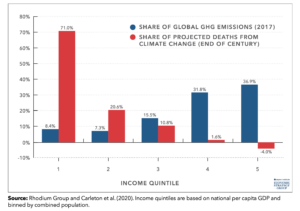
Much of the conversation at COP27 has focused on economic compensation and assistance for developing countries who will likely bear the greatest damages from climate change but contribute little to overall global emissions.
If carbon emissions are left unaddressed, the climate crisis will not only become more costly to global health and the global economy, but also will exacerbate inequality within the U.S. and around the world.
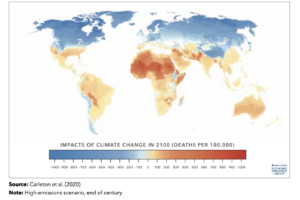
Projected changes in the frequency and severity of climate events vary starkly across local geographies and how these changes manifest is a major factor in shaping the economic impact of climate change around the world.
In a high emissions scenario, climate change could cost the U.S. 1.4 percent of GDP by 2030, growing to 2.4 percent of GDP by mid-century.
But climate change damages are also uneven and unequal. Hotter places tend to be poorer and less developed, leaving them vulnerable to the most pronounced effects of climate change without the resources needed to adapt.
Figure 12. Mortality Damage Function and Projected Change in Death Rate
Figure 14: Those Least at Fault Are Most at Risk
Countries’ share of current GHG emissions and projected increases in mortality from climate change by income quintile
To combat these challenges, AESG Author Trevor Houser emphasizes adaptation. In the US, this means preparing for the irreversible effects of climate change, including making coastal communities in the U.S. more resilient, expanding access to low-cost air conditioning, promoting climate-resistant crops in the plains states, and reducing wildfire risk.
As COP27 leaders negotiate over who will bear the costs of adaptation globally, they must also prepare for the reality of large-scale climate displacement.
The Inflation Reduction Act of 2022 (the “IRA”) represents Congress’ most substantial attempt to date to lessen American reliance on fossil fuels and to transition the country’s power supply toward zero-emission sources. Per the Joint Committee on Taxation’s estimate, the Act commits approximately $369 billion toward measures aimed at improving energy security and mitigating the ongoing and multiplying effects of climate change. The IRA relies predominantly on market-based incentives, including tax credits, direct subsidies, and other carrots to induce private investment in renewable energy sources, rather than on emissions caps, carbon taxes, or other sticks to penalize the continued use of fossil fuels.
This approach is in tension with the conventional economic wisdom that carbon pricing is the most efficient and cost-effective way to reduce carbon emissions, compared to alternatives such as clean energy subsidies or a clean electricity standard. In his 2021 AESG paper, “Harnessing the Power of Markets to Solve the Climate Problem,” Gilbert E. Metcalf of Tufts University advocates for a deterrent-based approach to emissions reduction. According to Metcalf, a serious and cost-effective response to climate change must include a carbon tax as its centerpiece, in addition to policies that “encourage greater amounts of zero-carbon research and development, regulations to reduce [greenhouse gasses] not easily included in a carbon tax, and various initiatives to reduce barriers to the transition away from fossil fuels.” While the IRA makes significant efforts toward these intermediary steps, Congress’ failure thus far to impose either a carbon tax or a cap-and-trade program may, according to Metcalf, prove insufficient for achieving net-zero carbon emissions in the coming decades.
There may be cause for optimism, however, that the IRA’s incentives-based approach will make greater inroads toward an American power supply that relies less heavily on carbon emissions. In their 2021 AESG paper, “Challenges of a Clean Energy Transition and Implications for Energy Infrastructure Policy,” Ryan Kellogg of the University of Chicago and Severin Borenstein of UC Berkeley concur with Metcalf that market-based incentives are necessary but not sufficient for decarbonizing America’s energy supply but stop short of recommending a carbon tax over other alternative incentives. They emphasize that decarbonization will require additional policy measures, including investment in and deployment of novel technologies; redesigning wholesale power markets; strengthening federal authority over long-distance transmission siting; and reforming retail electricity pricing.
Kellogg and Borenstein build on these ideas in a 2022 paper focusing on the electricity sector, which suggests that incentives such as a clean electricity standard and subsidies could result in a similar reduction in emissions from electricity generators as would a carbon price. Conventional wisdom has held that carbon pricing exerts the greatest economic toll on the heaviest polluters, while clean electricity standards instead ensure that polluters running the highest operating costs are the most affected. These standards were therefore thought not to account for the intensity of carbon pollution in determining which polluters first leave the market. But Borenstein and Kellogg find in their study that fossil fuel generators’ private operating costs are highly correlated with their emissions. Because the dirtiest fossil fuel emitters also incur the highest operating costs, they would as a consequence be the first to exit the market upon the imposition of clean electricity standards. In Borenstein and Kellogg’s model of the electricity market, a clean electricity standard that phases out fossil fuel generation achieves a similar effect on emissions reductions in the electricity sector over a similar time period as does a carbon tax.
In the same study, Borenstein and Kellogg suggest that clean electricity subsidies may also improve incentives to adopt cleaner energy. States with the cleanest electricity generation, including California and New York, also tend to have retail electricity prices that are much higher than marginal cost. To the extent that a carbon tax would further raise the retail price of clean electricity, this pricing scheme might discourage the adoption of cleaner energy sources; consumers, for instance, may be less motivated to replace their gas-powered cars with electric vehicles. Policies that reduce retail electricity prices through incentives, rather than raise such prices through taxes, may therefore be preferred on the path toward a zero-carbon energy grid.
AESG member Lawrence Summers and AESG director Melissa Kearney join Bloomberg TV’s David Weston to discuss what comes after the potential downturn and what the risks are of running out of workers.
The COVID-19 pandemic plunged the US economy into recession, challenged the survival of millions of businesses, and threatened the economic security of American households. The recession officially lasted only two months, ending in April 2020, but looming economic challenges remain and the path of the post-pandemic recovery is uncertain. The US labor market recovery is slow, global supply chains are disrupted, the pace of vaccination in the United States has stalled, and emerging variants of the virus threaten a return to pre-pandemic normalcy.
The pandemic also ushered in major changes to the US economy, many of which may persist even after the pandemic recedes. The sudden shift to working from home, changes in consumers’ preferences and habits, and the acceleration of technology adoption by businesses may have lasting effects on economic growth and inequality—for better or worse. Widespread school closures and the shift to remote instruction has impeded the educational and social development of US children and exacerbated already large disparities in learning, with potential long-term negative consequences.
At the same time, the pandemic and accompanying economic crisis prompted an unprecedented US policy response. Congress authorized trillions of dollars in spending to support businesses and households, staving off business failures and bolstering household income and savings. With aggregate demand now increasing, the US economy faces a new set of challenges—among them a higher inflation forecast driven by both demand and supply factors. The Biden administration and congressional Democrats are calling for trillions of dollars in federal spending on an ambitious package of health, education, early childhood, and climate initiatives, in addition to the $1 trillion bipartisan infrastructure package passed by the Senate in August 2021. Critics worry about the size and scope of the package, as well as the prospect of further deficit spending and higher taxes.
Amidst these domestic challenges, the geopolitical landscape facing the United States continues to shift, in particular with China’s rapid ascendance as a major economic rival able to wield greater economic and political influence across Asia and the much of the world. The need to maintain American competitiveness in this changing global context highlights the need for well-designed investments at home, in infrastructure, in human capital, and in basic science and technology.
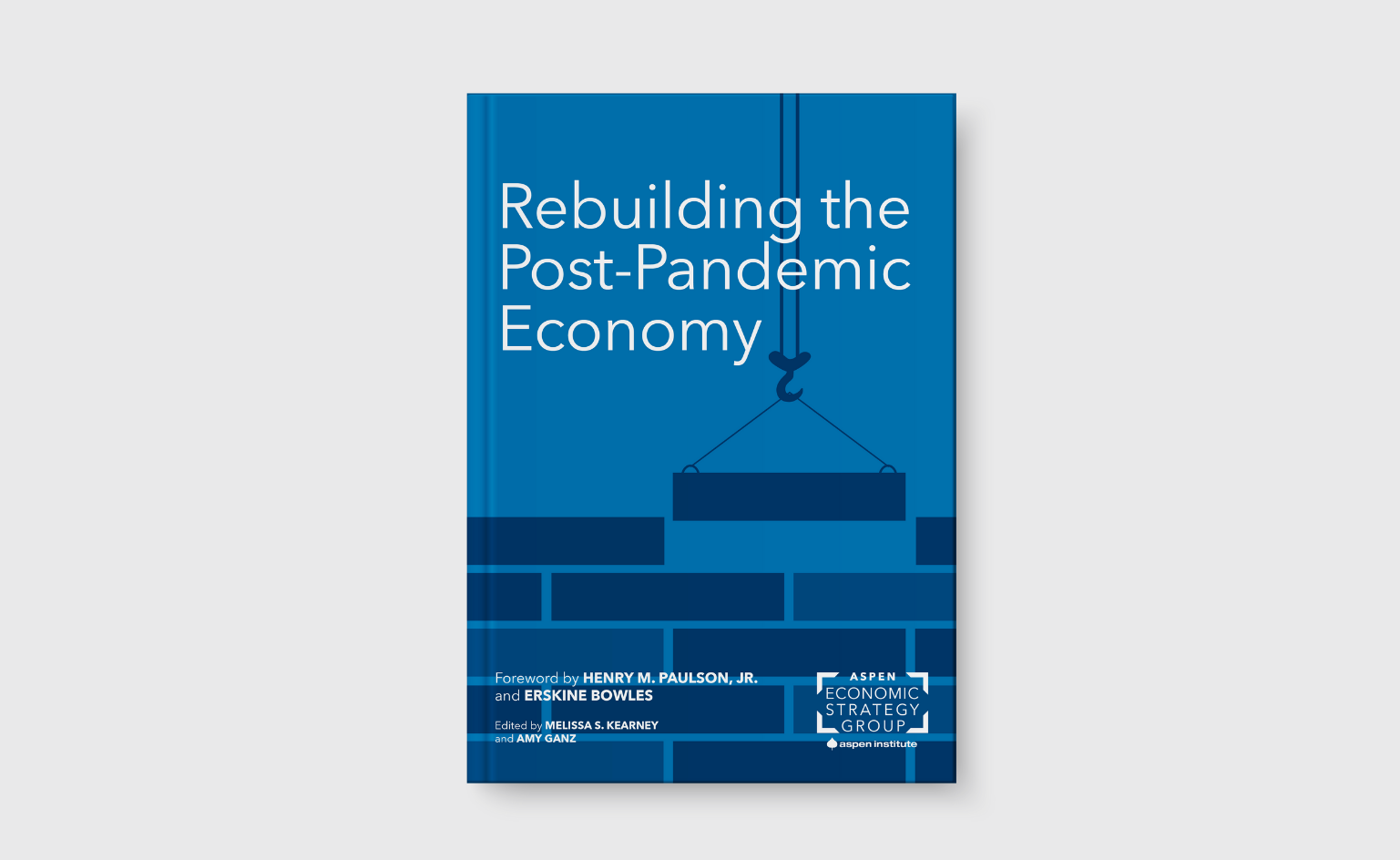
Rebuilding the Post-Pandemic Economy considers several current, major economic challenges facing the nation. Its eight chapters served as background reading materials for the Aspen Economic Strategy Group annual meeting in July 2021 and are now published as a resource for broader policy audiences.
Part 1 consists of five chapters that focus on various elements of the US economic recovery following the Covid-19 pandemic. Chapter 1 highlights productivity gains that could result from the sudden shift to working from home if US households were to have universal access to reliable, high-speed internet. Chapter 2 discusses lessons learned from the novel business recovery programs introduced during the pandemic and their applications for “garden variety” recessions. Chapter 3 presents strategies for preventing long-term unemployment and assisting workers whose jobs have been permanently lost as a result of sectoral reallocation. Chapter 4 discusses the underlying causes of longstanding inequities in the US K-12 education system, which were laid bare by the pandemic, and promising avenues for systemic improvement. Chapter 5 addresses the current state of American trade policy, including reforms to promote American geopolitical interests and economic recovery.
Part 2 consists of three chapters that focus on the US infrastructure agenda. Chapter 6 addresses the economics of infrastructure investment, emphasizing the central role of cost-benefit analysis in selecting projects. Chapter 7 focuses on federal regulatory reforms and infrastructure investments necessary to support the US economy’s transition to clean energy sources. Chapter 8 makes the case for greater federal investment in research and development (R&D) based on the extremely high social return on such investments and their role in promoting broader innovation and prosperity.
After suffering the worst economic shock since the Great Depression last year, the American economy is recovering in fits and starts. While many businesses are reopening their doors and thriving, others are struggling with tenuous demand, supply constraints, and higher labor costs. Americans are traveling, dining out, and resuming other activities that weren’t possible before vaccines. Yet, remaining uncertainty about the course of the virus continues to hamper a full return to normal activity.
The COVID-19 pandemic reinforced and exacerbated many of the biggest structural economic challenges in our society. It precipitated the largest economic relief and stimulus spending in US history and rewrote the playbook for responding to future economic crises. The pandemic also transformed the way that millions of Americans live and work, with automation, e-commerce, and telework all playing a bigger role.
The pandemic and its aftershocks reignited not only the perennial debates about the appropriate role and size of government, but also present new and urgent questions about how the post-pandemic economy will take shape.
What are some initial lessons we can take away from the novel government programs that were deployed to provide economic relief and stimulus? What kinds of investments do we need to make to our infrastructure so that it is once again the envy of the world? After a year of widespread school closures, what have we learned about the role of K-12 education in perpetuating or reducing social and economic inequities? And how should American trade policies evolve to promote economic recovery and strengthen America’s role in the global economy?
None of the answers to these questions are predetermined. The choices and actions of policymakers in Washington and around the country can and will make a difference.
This book is an attempt to elucidate some of the challenges and opportunities of the post-pandemic economy. At its core, it underscores that the challenge for economic policymakers is not simply to return to the pre-pandemic economy—rather, it is to rebuild an economy that is more prosperous, dynamic, fair, and resilient to future shocks in the post-pandemic era. We hope that the non-partisan, evidenced-based research and recommendations contained in this volume are helpful towards this end.