The Widening Economic and Social Gaps Between Young Men and Women

Recent social and economic data has revealed a troubling trend: young men in the US are increasingly falling behind their female peers, a long-widening gap that has accelerated in the wake of COVID-19. Many young men have struggled to navigate the disruptions associated with the pandemic, resulting in stagnating labor force participation rates, declining college enrollment, and increased social isolation.

This phenomenon is part of a longer trend of young men’s declining labor force participation. As shown in Figure 1, the average share of men 25-34 years old employed or looking for work has dropped from 92.4 percent twenty years ago, in August 2004, to 88.8 percent in August 2024. If labor force participation among young men today matched its August 2004 rate, over 700,000 more men would be in the workforce. On the other hand, over that same time, women’s labor force participation has risen from 72.8% to 78.5%

The decrease in labor force attachment comes at the same time as a significant drop in college enrollment after the pandemic, a trend highlighted in a previous AESG In Brief. Among men who had just graduated high school, just 55% enrolled in college in 2021, down from 62% in 2019, while these rates remained at 70% across this period for women. The most recent data indicates that men’s college enrollment rates have not yet recovered from their post-pandemic drop.

As young men are less likely to join the workforce or enroll in school, they are lives of increased isolation. As shown in Figure 2, men spend an average of 6.6 non-sleeping hours alone each day, compared to 5.4 hours for women. This represents an increase of over one hour spent alone daily compared to pre-pandemic figures. This increased isolation contributes to weakened labor market prospects through a narrowing of social networks.

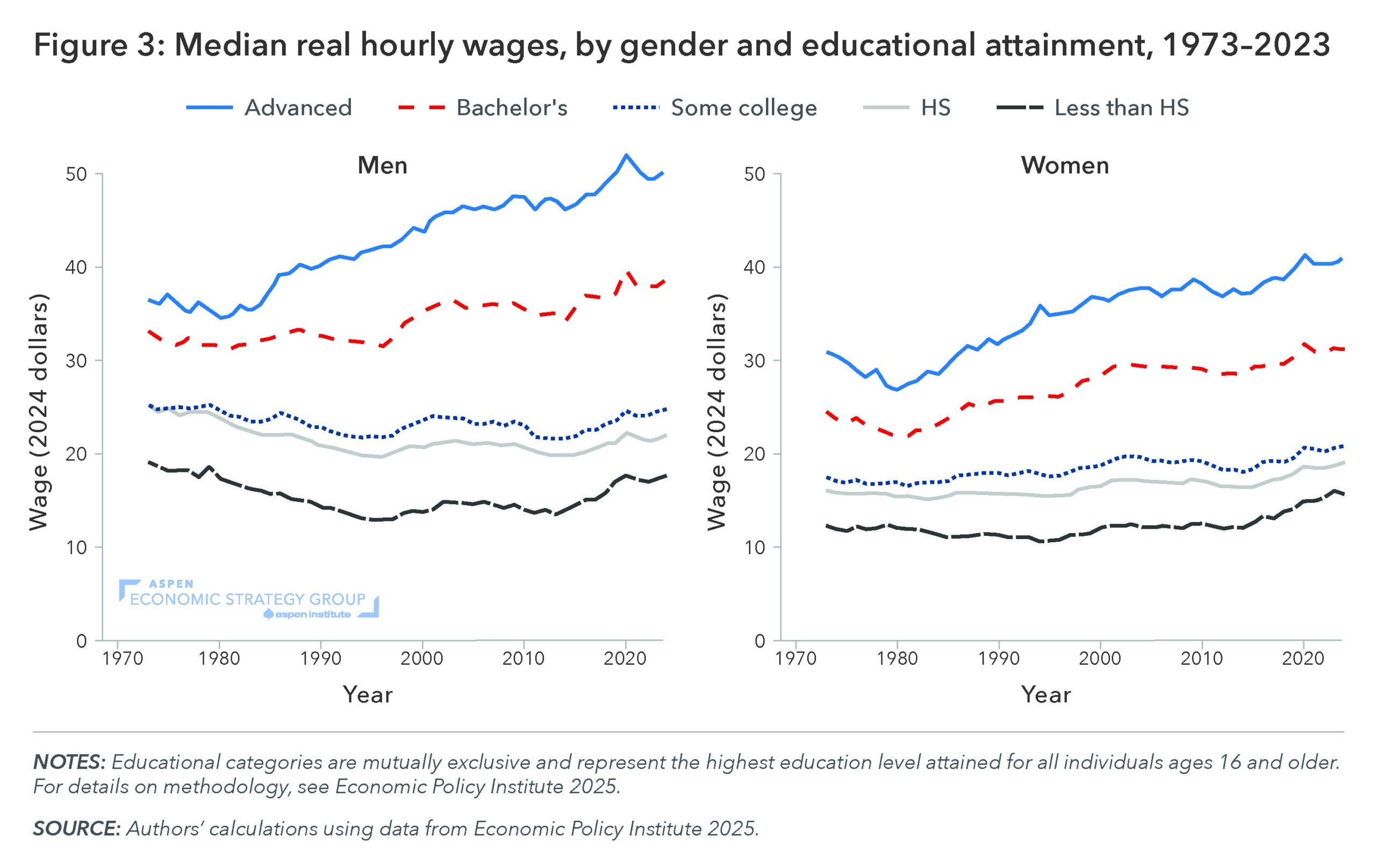
The declines in young men’s academic progress and social connectedness experienced during the pandemic could spell further worsening in labor market outcomes. In their 2019 AESG paper A Policymakers Guide to Labor Force Participation, Keith Hennessey and Bruce Reed highlight that men with lower levels of education have experienced the largest declines in labor market prospects from 1965-2019, as technological disruptions and competition from low-wage overseas workers reduced economic opportunities for non-college educated men. Over that time, labor force participation among men with a high school degree but no college experience fell by 14 percentage points, compared to a 4 percentage point drop among men with a bachelor’s degree. 

Helping young men today overcome the acute, pandemic-related disruptions they experienced just as they entered adulthood will take significant and widespread investments. Such efforts include ensuring those who want to enter college after pandemic-related disruptions are able to do so, restoring pathways to economic security outside of the college pipeline, and equipping young men with the social and emotional support to navigate this period in their lives  – but these investments will be crucial to building a productive, economically secure next generation.

August 2024 Jobs Report: The Summer Slowdown Continues

The BLS estimated that the US economy added 142,000 jobs in August, and the unemployment rate ticked down slightly from 4.3% to 4.2%. This report is far from a worst-case-scenario many had feared, but does tell a consistent story of a labor market that is moving from a phase of post-pandemic normalization into outright weakness. 

1. Job growth has slowed sharply over the past quarter

Today’s data first demonstrated that the weakness in last month’s report was not a fluke. Indeed, the estimate for employment growth in July was revised down a further 25,000 to just 89,000 jobs added. Taken with the revision for June, total job growth over the past two months was 86,000 lower than previously estimated. Over the past three months, we have seen a substantial slowdown in job growth compared to even just the beginning of 2024: in January, the three-month moving average of employment growth was 243,000 – now that average sits at just 116,000. For reference, the US economy averaged 190,000 jobs added per month pre-pandemic (over 2015 to 2019).

2. The labor market weakening is broad-based, with many industries losing jobs

Second, over the past several months, labor market weakness has spread to more industries and the signs of growth are increasingly restricted to a small number of sectors. In August, just two industries, Health Care and Construction accounted for more than half (80,000) of the 142,000 net increase in jobs. Moreover, for the first time since the onset of the pandemic, more industries have shed jobs over the past three months than have increased employment (from the BLS Employment Diffusion Index).

3. Job losers are having a more difficult time finding jobs

One bright spot in today’s report was that the unemployment rate ticked down from 4.3% to 4.2%, but this drop was almost entirely because the idiosyncratic factor driving last month’s uptick (a weather-related increase in workers on temporary layoff) fell back to normal levels. More importantly, over the past three months an increasing number of people are moving into the ranks of the unemployed when they enter the labor force (rather than immediately finding a job) and when they permanently lose their job (rather than finding new work). The US has avoided a more severe slowdown in large part because, when workers have lost their job, they have had a relatively easy time finding new work – but that has become increasingly difficult in recent months.

What it Means

The slowdown in the top-line job growth numbers, the broad-based weakening across most sectors, and the flow of workers from job loss into unemployment are all signs that the job market is significantly weaker than even just a few months ago – and is skirting the line between normalization and deterioration. All eyes will now be on whether the Federal Reserve lowers interest rates by 25 or 50 basis points later this month. What happens at the September meeting is much less important than where interest rates ultimately end up over the longer-term, but the underlying weakness in today’s report boosts the case for an aggressive start to the Fed’s rate-cutting cycle.

July 2024 CPI Report: Trending Towards Two

The steady cooldown in inflation that has marked much of 2024 continued in July. The Consumer Price Index rose at a 2.9% annual pace for all items, and at a 3.2% pace for all items excluding food and energy. These headline and core inflation rates are now at their lowest points since March 2021 and April 2021, respectively. Last month, the FOMC statement noted that members are looking for “greater confidence” that inflation is moving sustainably toward its 2% target before lowering interest rates, and the data in today’s CPI report should continue to build that confidence. 

First, more encouraging than the top-line numbers for July are the indications of where inflation is headed. Although core inflation has risen by 3.2% over the past year – still above the Fed’s target – trends in the data over the past three and six months indicate that inflation will continue to fall: over the past six months, core inflation is trending at a 2.8% annual rate, and if we look at just the past three months, it has fallen to a 1.6% pace, below the Fed’s target. 

Second, rising housing costs are the largest contributor to price growth right now, and that too is slowly trending down. Shelter prices accounted for 90% of the overall price growth in July, and removing that category, headline inflation was just 1.7% over the past year. The positive news is that shelter inflation in the CPI has been continually falling since reaching a peak of 8% last year: price growth for shelter fell to 5.0% in July, the lowest level since March 2022, and has been trending at a 1.9% annual rate over the past three months.

Today’s inflation readings, along with recent employment data, paint the picture of an economy that has steadily cooled down throughout 2024. The pressures that contributed to high inflation over the past few years – including a tight labor market – have eased. Smaller job gains and rising unemployment have contributed to the slowdown in price growth, and those dynamics make it more likely that inflation will continue to fall sustainably towards 2%.

Rising Childlessness is Driving the Decline in Birth Rates in the United States

The United States has experienced a dramatic decline in birth rates, starting in 2007 and continuing through recent years. This post updates and expands on findings in Kearney, Levine, Pardue (2020), The Puzzle of Falling Birth Rates in the United States, which concludes that the decline in birth rates has been fueled more by a higher frequency of women having zero children than by women having smaller families. 

As shown in Figure 1, the overall birth rate in the US, defined as the total number of births per thousand women aged 15-44, has fallen from a recent high of 69.3 in 2007 to 56.0 in 2022. In recent years, the birth rate dropped from 58.3 births in 2019 to 56.0 in 2020 (a drop that Kearney and Levine (2021) contribute to COVID and that seems to be bigger for second births), before rebounding slightly to 56.3 in 2021 and ultimately returning to that multi-decade low of 56.0 in 2022. 


Figure 2 extends data in Kearney, Levine, Pardue (2020), charting birth rates by parity (birth order). From 2007 to 2022, first births declined from a rate of 27.6 per 1,000 women aged 15-44 to 21.5, a drop of 6.2 births. Second births declined from 21.9 to 17.7, a drop of 4.1 births. The birth rate for third-order declined by 2.3 from 11.6 to 9.3. Fourth or higher order births fell by 0.5 births. Although first, second, and third-order births declined by similar proportions (22%, 19%, and 20% drops, respectively), in absolute terms the drop of 6.2 first births can account for about half of the 13.3 total decline in birth rates over that period.

The rise of childlessness is also apparent in recent survey data. Figure 3 plots data from the Current Population Survey’s June Fertility Supplement. The share of women ages 35-44 reporting zero children ever born has risen from 16.1% in 2012 to 20% in 2022. Women reporting 1 or more children born rose 1.6 percentage points, and every other group (2 children, 3 children, 4 children, and 5 or more children) declined or were relatively flat over this period. Furthermore, the rise in women 35-44 reporting no children ever born is seen across nearly every demographic group – by family income, race and ethnicity, geography, and employment status.

Kearney, Levine, and Pardue (2020) find little evidence of a relationship between the decline in fertility and recent policy or economic changes over that period. This shift, instead, is likely a reflection of changing priorities of recent cohorts of US women, including life aspirations and preferences for having children.

Regardless of the cause, Kearney and Levine note in a 2020 AESG policy paper that these demographic trends pose a significant headwind to future economic growth. Should the drop in fertility continue, the US working-age population will decline within the next decade, leading to a smaller labor force and slower growth; second, an older workforce could drive lower innovation and productivity growth; finally, the imbalance between younger and older workers would further strain entitlement programs, such as Social Security and Medicare, which rely on taxes paid by current workers to fund benefits for older retirees.

June 2024 CPI Report: The Summer Cooldown Continues

The Consumer Price Index rose at a 3.0% annual pace in June 2024, and 3.2% for all items excluding food and energy. Three things stood out from this report.

1. Core CPI Hits Lowest Level in Three Years

While markets expected a small increase in prices from May to June, the Consumer Price Index declined by -0.1%, and over the past year prices have risen by 3.0%. Among items in the core CPI, which excludes food and energy, prices rose by 0.2% since last month and by 3.3% over the past year. The 3.3% increase in the Core CPI is the smallest gain since April 2021.

2. Recent Trends Paint a More Encouraging Picture

After inflation started this year much hotter than expected, prices in recent months have been falling steadily, and more frequent measures of inflation trends reflect this progress. Headline inflation fell to 3% in June, from a recent high of 3.5% in March. If price trends in the three months since March continue for 12 months, annual inflation would hit 1.1% – far below the Fed’s 2% inflation target. Core inflation, which is a more reliable indicator of underlying trends, shows similar progress: the past three months show annual inflation is trending just near target at 2.1%.

3. Declining Prices Have Been Broad-Based

One of the most encouraging signs in today’s report was the decline across several groups within the Core CPI, suggesting this data represents the start of a sustained fall in inflation rather than a one-month blop. Within core goods, prices for used cars continue to fall, dropping by 1.5% since last month. WIthin services, airfare prices registered a 5% drop.Most notably, shelter prices rose by just 0.2% over the last month, the smallest increase in that category since August 2021. 

What this means:

The June employment report indicated that the labor market is entering a new period of slower growth, and the inflation report for that month should lead to the same conclusion about prices. It has become clear by now that the uptick in inflation at the beginning of the year was more noise than signal, and data since March has shown prices getting back on their disinflationary track. Core inflation is now at its lowest level in three years and, if the last three months are an indication, is sitting right now just at the Fed’s target. Taking these inflation trends together with the slower pace of job growth and rising unemployment, the question now becomes whether this summer cooldown turns into a fall chill.

June 2024 Jobs Report: Entering a New Phase of the Job Market

The BLS estimated that the US economy added 206,000 jobs in June, with the unemployment rate ticking up from 4.0% to 4.1%. Three things stood out beneath the headlines of this report.

1. Revisions to April and May Show a Softer Job Market

While the topline number of 206,000 jobs added in June was about in line with market expectations, the biggest signal in today’s report were the revisions of job growth in April and May. After today’ report, employment growth over those past two months was revised down by a combined 111,000 jobs. Accounting for June’s data and those prior revisions, the three-month average of job gains now stands at 177,000 jobs, the lowest this measure has reached since January 2021.

2. Unemployment Rate Has Started to Steadily Tick Up

As monthly job gains have slowed, the share of workers looking for work but unable to find it has consistently risen in recent months. The path of the unemployment rate can be characterized in two general period since coming down after the pandemic: for 12 months starting in April 2022, the unemployment rate held steady between 3.4% and 3.6%; for the next year it stayed between 3.7% and 3.9%, over the past two months it has ticked up to 4% and now 4.1%. That’s the highest level since November 2021, another indication that the job market has reached a new, cooler period.

3. Wage Growth Reaches Post-Pandemic Low

Last month’s data featured strong job gains and an uptick in wage growth. Along with the downward revisions to job growth, the earnings data in today’s report shows a return to the gradual cooldown in wage pressures. Indeed, among all employees, average hourly earnings grew by 3.86% over the past year, the lowest rate of growth in the post-pandemic recovery period.

What this means:

Nearly all major data points in today’s employment report indicate we are entering a new phase of the job market. At the start of this year, the labor market looked surprisingly resilient, but the slower job growth, higher unemployment, and moderate wage gains seen in June all point to a labor market that is now quite close to a healthy “normal.” This softening, taken together with the significant cooldown in inflation over the past two months, should set policy makers up to start bringing down interest rates later this year.

May 2024 CPI Report: Can the US Economy Have it All?

The Consumer Price Index rose at a 3.3% annual pace in May 2024, and 3.4% for all items excluding food and energy. Three things stood out from this report.

1. Inflation Softens More Than Expected

Overall, consumer prices were unchanged from April to May and rose by 3.3% over the past year. Core CPI, excluding volatile goods and energy prices, rose by 3.4%, the lowest level since April. Forecasters were expecting the total CPI to rise by 3.4%, but falling gas prices, which dipped by 3.6% over the past month, helped to push the price index down.

2. Housing Costs Keep Inflation Elevated

Declining gas prices helped to tamp down inflation in May, but still-rising housing costs are preventing a faster decline in the price index. Housing costs have been very slow to come down from their post-pandemic high, with the shelter component of the CPI rising by 5.4% since last May. Shelter makes up 36% of the total CPI, and high costs have played a large role in keeping inflation elevated. In May, shelter costs alone accounted for 57% of the rise in all prices over the past year.


3. Core Inflation Hits a Three-Year Low 

The 3.4% increase in prices outside of food and energy was the slowest pace in over three years. This core index is considered a reliable indicator of underlying trends in overall inflation, and May’s data marks the continuation of a slow but steady descent – this time last year, core prices were rising by 5.3%. Indeed, by more recent measures, core inflation is set for further improvements. Looking at the past three months, core inflation is trending at a 3.2% annual rate, and the annualized pace of this past month’s change is 2.4%.

What this means:

The May employment report’s larger-than-expected job growth and wage gains opened the question of how hot the US economy continues to run – and whether interest rate cuts amid such solid data are appropriate. But today’s CPI data send a strong signal that this economy can manage both strong job growth and falling inflation at the same time. While no single report should alter the outlook too much, May’s data should make policymakers much more confident inflation continues on the path back to their 2% target.

May 2024 Jobs Report: Mixed Messages in the Job Market

The BLS estimated that the US economy added 272,000 jobs in February, with the unemployment rate ticking up from 3.9% to 4.0%. Three things stood out beneath the headlines of this report.

1. Job Growth Accelerates

Today’s estimate of 272,000 jobs added substantially beat the consensus market forecasts of 180,000, and by all measures is consistent with a strong and growing economy. The three-month average of 249,000 jobs added exceeds both the pre-pandemic average (190,000 jobs) and upper estimates of the pace needed to keep up with current population growth (230,000 jobs). Despite consistent expectations that employment growth will slow, this latest report is another sign that the momentum this job market has built over the past few years will not disappear quickly.

2. Wage Growth Ticks Up

As the job market continues to expand, firms increased wages faster than expected in May as well.  Average hourly earnings for all workers grew by 4.1% over the past year, an uptick from the 3.9% rate of growth last month. This uptick is small in comparison to the large decline in wage growth we have seen since 2022 when pay was rising at a 5.9% pace. But the jump is also a sign that the job market is still strong and is driving pay increases that, in turn, are making it less likely inflation will quickly fall.

3. Unemployment Rises and Labor Force Participation Dips

Although the top-line estimates of employment and wage growth pointed to a still stronger-than-expected job market. The May jobs report did flash some warning signs that the job market may be slowing down. First, the unemployment rate hit 4% for the first time since January 2022, when it was falling from the pandemic-induced highs. This share of adults looking for work but unable to find a job has been slowly but steadily rising from the post-pandemic low of 3.4% in recent months. Second, the unemployment rate can sometimes rise for a good reason – because more adults start to look for work – but this was not one of those times. The labor force participation rate fell from 62.7% to 62.5% in May and has been stuck well below pre-pandemic levels for the past four years. These twin trends – of a smaller share of adults looking for work and, when they are, having a harder time finding jobs – will make it difficult for the economy to continue growing as quickly as it has recently.

What this means:

While this jobs report, on the net, came in stronger than expected, it was by no means a blockbuster report. Faster-than-expected job growth and wage growth demonstrate that the economy is not slowing at the pace many expected, but the uptick in the unemployment rate and continued stall-out in labor force participation are concerning signs that make clear the economy will not remain this strong indefinitely. If these trends continue, job market conditions will not prevent policymakers from lowering interest rates later this year.

In Brief: Building Security in the Semiconductor Supply Chain

Download (PDF)

BRIEFLY

Semiconductors are the building blocks of almost every modern technology, from dishwashers to smartphones to javelin missiles. Shortages during the COVID-19 pandemic, along with rising geopolitical tensions in the region where most chips are produced, have highlighted the fragile supply chains of this critical technology. In response, US policymakers have invested billions in the domestic production of this critical technology, through incentives to semiconductor manufacturers and investments in US research and development. Nearly two years on from the start of this effort, as incentives continue to be awarded, policymakers can raise the likelihood that the US achieves greater security in the semiconductor supply chain by (1) continuing to award incentives to facilities located in high-talent areas, (2) allowing highly skilled foreign workers to fill in-demand positions, and (3) following through on announced investments in the domestic STEM (science, technology, engineering, and mathematics) talent pipeline.

WHAT TO KNOW

Over time, both global competition and the economies of scale that characterize modern chip manufacturing have resulted in a concentrated and fragile supply chain. From 1990 to 2020, the global share of semiconductors, or computer chips, produced in the US fell from 37 percent to 10 percent. Today, countries in East Asia account for 73 percent of total semiconductor production capacity, and that region manufactures nearly all of the most advanced chips needed to run the newest technologies. Indeed, in 2020, only two companies—South Korea’s Samsung and Taiwan-based Taiwan Semiconductor Manufacturing Company (TSMC) —could manufacture leading-edge “logic” chips that process data in devices like tablets and smartphones. During the pandemic, increased demand for consumer goods caused shortages among both advanced and older-model legacy logic chips (such as those found in cars). Those shortages, coupled with rising prospects of tensions with China over control of Taiwan, have spurred efforts to rebuild America’s capacity to manufacture semiconductors domestically.

The 2022 CHIPS (Creating Healthy Incentives to Produce Semiconductors) and Science Act aimed to rebuild the country’s semiconductor manufacturing capacity and increase investments in long-term research-and-development pipelines. The law includes $52.7 billion in appropriations to bolster the semiconductor industry through 2026, among them $39 billion earmarked to incentive firms to build chip facilities in the US, and $11 billion earmarked for investment in advanced-chips R & D. The CHIPS Act also created an Advanced Manufacturing Tax Credit, intended to encourage private-sector investment in the industry; the Congressional Budget Office projects this credit will cost $24.5 billion. On the heels of the CHIPS Act, state and local policymakers have announced an estimated $7 billion in additional incentives to attract semiconductor facilities to their cities and states. In total, leaders from the local to the federal levels have devoted $84.2 billion to incentivize domestic chip manufacturing.

Table 1: An estimated $84.2 billion in public funds have been directed to spur US semiconductor production across federal, state, and local efforts

Source: CHIPS for America and tax credit funding from Congressional Research Service (2023). State and local incentives from the Tax Foundation (2024).
Note: Included in “other” spending in the CHIPS for America Fund is $200 million for CHIPS-related workforce development, $500 million for information and communications technology security, and $2 billion for defense-related semiconductor manufacturing.

Nearly two years after the passage of the CHIPS and Science Act, $54.4 billion in grants and loans have been awarded to semiconductor manufacturers. The Department of Commerce’s CHIPS for America Program Office posted its first Notice of Funding Opportunity for incentives to build chip manufacturing facilities in February 2023. Producers seeking awards in the form of grants or loans have been submitting applications for funds on a rolling basis, with the first award announced in December.  As shown in figure 1, $29.3 billion in grants and $25.1 billion in loans have been announced through May 2024. Incentives awarded to GlobalFoundries, Microchip Technology, and BAE systems are aimed at building legacy chips. The US-based technology company Intel, a longtime chipmaker that has fallen behind foreign competition in recent years, has received the largest share of grants and loans for both legacy and leading-edge chip production. Finally, TSMC was awarded a combined $11.6 billion in grants and loans to produce among the world’s most advanced chips in a new Arizona facility.

Figure 1: $54.6 billion in federal CHIPS manufacturing incentives have been awarded

Source: “Other” grants were awarded to Absolics, BAE Systems, Microchip Technology, and Polar, totaling $392 million. Funding data as of May 29th, 2024.
Note: Semiconductor Industry Association (2024a) 3390.

Table 2: Workers in semiconductor manufacturing are more likely to have a BA or advanced degree than workers in other industries

Source: American Community Survey (2022), via IPUMS.
Note: Semiconductor manufacturing workers are identified as those listed under NAICS codes 3344 and 3346.

As funds are allocated and production facilities are built, one of the most important undertakings will be to ensure that there is a supply of skilled workers able to fill these roles. The domestic semiconductor manufacturing workforce, numbering about 203,000 today, is expected to grow substantially as a result of policymaker efforts. The Semiconductor Industry Association estimates that about 115,000 domestic jobs will be added across the design and manufacturing of chips.

These design and manufacturing roles are highly technical and require specific training. Production of chips requires skilled machinery operators, electrical engineers, and materials science PhDs, among others, with training that ranges from 2-year degree programs to PhDs. As shown in table 2, workers in the semiconductor industry in the US today are more likely to have associate’s degrees, bachelor’s degrees, and master’s or doctoral degrees compared to both the entire workforce and other manufacturing sectors.

First, given the specific goals of this effort and the high level of skill required for semiconductor manufacturing, advancing the chip industry is more likely to be successful if facilities are located near skilled workers who can meet these firms’ needs. The CHIPS and Science Act has been viewed by some as the centerpiece in a new strategy of “place-based industrial policy,” in which policies intended to stimulate critical sectors can also revitalize distressed communities. The tension between these two goals of place-based industrial policy—advancing highly specialized manufacturing and promoting economic development—is evident in figure 2. This figure plots US metro areas by their prime age employment rate (a higher rate is indicative of less economic distress) and the share of all adults 25 and older who have a BA or greater in a STEM field (a higher share is an indicator of a more skilled local workforce in that area).

Figure 2: CHIPS investments are primarily being made in areas with above-average STEM talent and above-average employment rates

Source: Employment rates and portion of population with STEM degrees from US Census Bureau American Community Survey Summary Tables (2024a and 2024b); CHIPS awards and private-investment announcements from Semiconductor Industry Association (2024a and 2024b).
Note: Dashed lines indicate the average of employment rates and STEM degrees across metro areas.
The data underlying this graph can be downloaded here.

There simply are very few distressed local economies that are likely to have a sufficiently skilled workforce to meet the needs of manufacturing firms—that is, that lie in the upper left quadrant of the chart. To be sure, as Tim Bartik laid out in a recent AESG policy paper, policymakers have a menu of options at their’ disposal for investing in local economies, but conflating the goal of rebuilding semiconductor manufacturing with that of raising community development is unlikely to achieve either aim.

Figure 2 identifies both federal awards and private investments in chip manufacturing so far (in blue and red, respectively). These investments tend to be in areas with both high STEM talent and above-average employment rates. Indeed, many funding announcements are set to expand production in existing manufacturing clusters, such as Arizona’s “Silicon Desert.”

While firms locate investments in high-talent areas, policymakers should facilitate high-skilled immigration, particularly among workers with experience in the semiconductor industry. Immigration reform is perhaps the lowest-hanging fruit for quickly raising the supply of talented workers. As displayed in table 3, over one-third of workers in the semiconductor industry (34 percent) are foreign-born, more than double the share across the workforce (18.4 percent).

Table 3: Over one-third of workers in semiconductor manufacturing are foreign-born

Source: American Community Survey (2022) via IPUMS.
Note: Semiconductor manufacturing workers are identified as those listed under NAICS codes 3344 and 3346.

Analysts at Georgetown’s Center for Security and Emerging Technology (CSET) estimate that staffing new chip facilities will require 3,500 new foreign workers. While many of them could move from other industries or come from US universities, allowing immigration from foreigners with skill in manufacturing chips will also allow firms to bring in workers with valuable hands-on experience. Organizations in the US like the Economic Innovation Group have crafted proposals to allow for semiconductor industry–specific immigration reform. As other countries such as Japan raise immigration thresholds to attract skilled global talent, the US ought to enact such reforms as well.

Such reforms to the immigration system are more important because fewer students are graduating from US higher-education institutions prepared for work in the semiconductor industry. As shown in figure 3, growth in the number of US graduates with degrees in semiconductor-related fields, such as materials science, physics, chemistry, and computer science (as defined by CSET), has stalled out recently. In fact, from 2021 to 2022, the total number of degrees conferred in these fields fell from roughly 286,000 to 282,000. Looking just at advanced degrees, the trend is even more alarming: among master’s and doctoral graduates, the US has been on a decline since 2017.

Both the total decline and the drop in advanced degrees have been driven by the sharp decrease in the number of nonresident US students, many of whom typically stay in the US on work visas after graduation. Just over 18,000 fewer nonresidents completed doctoral degrees in semiconductor-related fields in the US in 2022 than did at the peak in 2017.

To build a skilled talent pipeline across all education levels, policymakers should follow through on investments in the CHIPS and Science Act. The law authorized $174 billion in spending over five years to STEM workforce development and R & D through several agencies—including an $81 billion increase in funding to the National Science Foundation (NSF). Unfortunately, these increases have not come through in recent spending packages: appropriations across these agencies for 2024 were $10 billion lower than the CHIPS and Science Act authorized, and in fact they cut the NSF budget.

Figure 3: Degrees in semiconductor-related fields have leveled out in the US

Source: Awards and degrees conferred by program and degree level at US institutions from Integrated Post-Secondary Education Data System (2022).
Note: Semiconductor-related programs are defined in Hunt and Zwetsloot (2020a). The data underlying this graph can be downloaded here.

Figure 4: Actual spending on STEM programs has lagged behind CHIPS Act funding

Source: Mui (2024).
Note: Funding included for the National Science Foundation, the Department of Energy’s Office of Science, the National Institute of Standards and Technology, and the Economic Development Administration’s Tech Hubs program.

Skilled workers will be more in-demand as other measures aimed at bolstering America’s advanced manufacturing capabilities take effect as well. The Inflation Reduction Act, for instance, includes $47.7 billion in funding for clean energy manufacturing, including producing advanced electric batteries domestically. A recent report by researchers at the Upjohn Institute estimated that employment in domestic lithium-ion battery production, another sector that requires advanced technical training, will grow by 247,000 by 2030. As demand for a skilled workforce rises—just as a result of the laws Congress has already passed—creating a skilled workforce will be critical to achieving these policy goals.

THE BOTTOM LINE

The nearly two-year-old effort to rebuild America’s semiconductor manufacturing capacity will soon move from the phase of announcing awards to getting money out the door and, ultimately, producing chips. Encouragingly, most public and private investments announced thus far are being made in highly skilled areas across the country, a sign that companies are taking the talent needs of this industry seriously. But policymakers are also failing to use this chance to build a more skilled workforce by facilitating greater high-skilled immigration and investing in the country’s domestic talent pipeline—steps that will also be useful as the US seeks to build independence in other advanced manufacturing industries.