America’s Risky Debt: What Markets See That Policymakers Don’t
For decades, global investors were willing to pay a premium for the safety and liquidity of US Treasurys. That premium has eroded in recent years, and bond investors and monetary policymakers now disagree on how to price US government debt. In America’s Risky Debt: What Markets See That Policymakers Don’t, Hanno Lustig argues that markets and policymakers are now operating under different views of US debt. He points out that this dynamic raises the risk that monetary policymakers suppress the market signals that fiscal policymakers rely on to assess debt sustainability and makes several policy recommendations to restore price discovery within the Treasury market.
Monetary policymakers and regulators maintain a “safe-debt” view, assuming that government obligations will be paid off with certainty by future tax revenues and that the Federal Reserve will contain inflation. This view can be seen in the analytical models and regulations policymakers use. For instance, US banks do not have to hold extra capital against their holdings of Treasurys, even when these are long-dated bonds exposed to significant interest-rate risk.
Investors, however, increasingly question the safety of US debt and have re-priced it as a risky claim. Lustig points to three pieces of evidence that the safe-debt view in the market has eroded since 2020:
- US Treasurys are no longer expensive relative to close substitutes like AAA-rated US corporate bonds or other foreign sovereign debt.
- The historically negative correlation between US stocks and bonds has flipped, and investors no longer flee to the safety of Treasurys during stress events.
- Foreign reserve managers are diversifying away from dollar-denominated assets.
The shift away from the safe-debt view among market participants coincides with changes in the structure of the Treasury market that make it particularly sensitive to sudden shocks: the maturity profile of Treasury debt is shortening, regulation-driven balance sheet adjustments have lessened the role of certain large banks (“primary dealers”) as shock absorbers, and more price-sensitive hedge funds are now playing a larger role in the Treasury market. Because of these structural vulnerabilities, monetary policymakers operating under an outdated safe-debt frame routinely misinterpret fiscal-driven sell-offs as mere bond-market “plumbing” problems.
With public debt projected to continue to rise, the US must eventually rely on primary surpluses, an inflation tax, or financial repression to manage its obligations. Financial repression occurs when a central bank artificially holds interest rates below market levels so the government can service its massive debt cheaply. While this mechanism provides temporary relief for fiscal authorities, it creates an implicit fiscal dominance that acts as a hidden tax on bondholders and other savers. Routinely buying back Treasurys to fix supposed plumbing issues ultimately suppresses the market price signals that would call for fiscal discipline in Congress, enabling continuous debt accumulation.
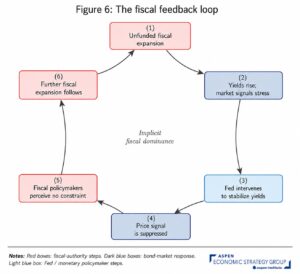
Lustig warns that if central banks continue relying on an outdated safe-debt framework, the ultimate result will be severe financial repression or high inflation. To restore genuine price discovery within the Treasury market, he proposes several reforms:
- Define market dysfunction: Monetary policymakers should publish clearer ex-ante criteria for what constitutes Treasury market “dysfunction,” though that distinction may be difficult to make in real time.
- Establish a new Fed-Treasury accord: The Fed should commit not to intervene in the Treasury market outside narrowly defined money-market plumbing functions. Such an accord must be paired with explicit accountability arrangements: ex-post legislative review of balance sheet interventions and clear exit conditions.
- Abandon the safe-debt model: Monetary authorities should abandon the safe-debt model, rather than continuing to treat Treasurys as unconditionally safe in stress-testing exercises, capital frameworks, and forecasting models.
- Strengthen market architecture: Regulators should make the plumbing of the financial system resilient enough to withstand shocks without central bank bailouts by reforming Treasury market structure to reduce the risk posed by any single party and recalibrating balance sheet regulations for large banks that act as intermediaries in the Treasury market.
Suggested Citation: Lustig, Hanno. 2026. “America’s Risky Debt: What Markets See That Policymakers Don’t.” In The American Economy in a New Era, edited by Melissa S. Kearney and Luke Pardue. Washington, DC: Aspen Institute.