
Stablecoins After GENIUS: Private Money, Public Debt, and the Global Dollar

The 2025 GENIUS (Guiding and Establishing National Innovation for US Stablecoins) Act established the first comprehensive US regulatory framework for US dollar (USD)-backed stablecoins, setting the stage for significant growth of these digital assets in the coming years. In Stablecoins After GENIUS: Private Money, Public Debt, and the Global Dollar, Nellie Liang and Brent Neiman describe how stablecoins fit within the financial system, outline the advantages and risks they pose, and offer recommendations for accommodating the growth of the stablecoin market while managing associated risks.
Stablecoins are privately issued assets designed to maintain a stable value relative to the US dollar. They are backed by liquid reserves, mainly short-term Treasury debt. Stablecoins operate on a decentralized, distributed blockchain ledger system that the issuer does not unilaterally control.
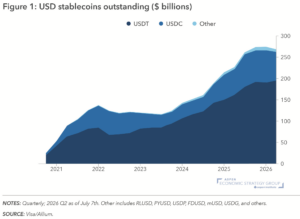
The total supply of USD stablecoins has grown more than tenfold in six years, rising from $24 billion in 2020 to $270 billion in June 2026. Estimates for overall stablecoin growth range from $500 billion to $5 trillion by 2030 as their use in real-economy payments grows, particularly in business-to-business transactions.
The authors frame their analysis of the stablecoin market around three features, each with advantages and risks, paired with policy recommendations.
1. The advantages provided by stablecoins’ decentralized structure must be balanced against the operational risks they pose. Stablecoins offer a number of advantages, including increased settlement speed, 24/7 availability, and lower transaction costs. For instance, the authors estimate stablecoin-based cross-border transfer fees range from 1 to 4 percent, compared to global remittance fees that average approximately 6.4 percent on a $200 transfer. However, their decentralized structure reduces consumer safeguards, risks run-like instability during market stress, and invites illicit finance through anonymous peer-to-peer transfers that bypass traditional enforcement tools.
The authors recommend that regulators set capital, liquidity, and risk management standards to ensure stablecoins maintain their convertibility at par (that is, $1 per token) in times of stress; consider restricting stablecoin transactions to registered private wallets held at regulated custodians that meet international AML/CFT standards; and build mechanisms to give consumers recourse when they are defrauded or make errors.
2. The fiscal benefits of increased demand for Treasury debt also create risks to the financial system. While not designed as a fiscal instrument, stablecoins increase demand for Treasury bills (T-bills), which in turn reduces federal borrowing costs. Depending on the growth scenario, net new T-bill demand could reach 26 percent of T-bills outstanding by 2030. Yet, this benefit should be balanced against risks that come from increased variability in debt service, lost seigniorage revenue, and reduced availability of credit to small businesses.
To manage these risks, Treasury should evaluate how to incorporate new demand into its models of debt issuance to determine the optimal debt maturity structure. Authorities should also enforce existing bans on stablecoin interest payments to prevent sudden deposit flight from traditional banks that local businesses rely upon for credit.
3. While the growth of USD stablecoins may reinforce the global role of the dollar, it can also raise concerns among foreign authorities. High international adoption of stablecoins strengthens US dollar dominance, but foreign authorities will likely have concerns about the growing use of USD stablecoins in their economies — namely, that it might erode their monetary sovereignty through a weakening of monetary policy transmission. If such concerns are left unaddressed, foreign policymakers might enact policies resisting this growth.
Liang and Neiman advise that US officials must work closely with foreign regulators to preserve the benefits generated by the use of USD stablecoins while addressing cross-border risks and minimizing spillovers that threaten foreign monetary stability.
The authors conclude that greater USD stablecoin adoption could create value on net for the US in the near- to medium-term, but stablecoins do not yet have sufficient protections for users or against illicit finance. Over the long term, substitution away from money settled by the central bank could create more fundamental risks to the structure of the financial system, as in the “wildcat” banking period in the US in the 1800s. The authors emphasize that, given current and projected trends, maintaining the status quo is not a feasible choice, but policymakers can positively influence the role USD stablecoins play in the future global payments system.
Suggested Citation: Liang, Nellie and Neiman, Brent. 2026. “Stablecoins After GENIUS: Private Money, Public Debt, and the Global Dollar.” In The American Economy in a New Era, edited by Melissa S. Kearney and Luke Pardue. Washington, DC: Aspen Institute.