
Skills Alignment for the AI Economy: A Framework for US Labor Market Policy

As generative artificial intelligence (AI) diffuses across the economy, speculation about its impact on the labor market continues to grow. In Skills Alignment for the AI Economy: A Framework for US Labor Market Policy, Robert Seamans evaluates the labor market effects of AI to date and outlines policy recommendations to manage this transition.
Seamans highlights three key trends in AI adoption. First, firm-level adoption is increasing but remains far from universal. According to August 2026 data from the US Census Bureau’s Business Trends and Outlook Survey, approximately 22 percent of firms currently use AI and 26 percent expect to use it within six months. Second, many workers adopt generative AI tools before the technology is formally implemented at the firm level. This informal “shadow AI” use by individual employees often outpaces firm-level adoption, suggesting that actual workplace integration is higher than official metrics capture. Third, AI adoption varies significantly across geographies and demographics. For instance, Microsoft telemetry data show a stark urban-rural divide in adoption rates: large metropolitan areas have approximately 33 percent adoption compared to 16 percent in rural counties.
In Seamans’ assessment, official labor market data have not yet shown evidence of widespread AI-driven job displacement. Studies have found that AI increases individual productivity, particularly for less experienced workers, yet these task-level productivity gains do not automatically aggregate into employment, wage, or firm-level effects. For instance, within entry-level employment, the evidence indicates that AI may be disrupting specific pipelines, particularly in software and some professional services, but is not yet producing any broad labor market displacement.
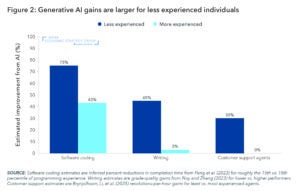
The combination of strong task-level productivity gains but no evidence of broad labor market disruption to date, Seamans argues, calls for policies that improve labor market adjustment rather than react to assumed mass job losses.
He lays out a “Skills Alignment Framework” to strengthen the feedback loop between employers, workers, and training providers, accompanied by several policy recommendations that benefit both employers and workers:
- Promote AI-enabled skill training to retrain displaced workers and leverage machine learning to predict how well a worker’s skill set suits particular job openings.
- Scale proven workforce training models, including apprenticeships, sectoral partnerships, and customized job training programs.
- Modernize existing labor market adjustment efforts, including unemployment insurance and federal workforce training systems, to help workers navigate economic disruptions.
- Expand wage insurance, which can speed reemployment and smooth income losses, particularly for older dislocated workers.
- Address the tax code’s preferential treatment of capital, which may distort a firm’s choice between workers and machines.
- Improve the national statistical infrastructure to ensure policymakers can monitor labor market trends and evaluate the effects of policy interventions.
Seamans cautions against AI-specific policy proposals, such as assistance programs targeted to AI-driven job losses and “robot taxes.” Determining whether layoffs were directly caused by technological adoption is administratively impractical, while implementing a robot tax risks penalizing productive investment, slowing the diffusion of efficiency-enhancing technologies, and inhibiting growth.
Suggested Citation: Seamans, Robert. 2026. “Skills Alignment for the AI Economy: A Framework for US Labor Market Policy” In The American Economy in a New Era, edited by Melissa S. Kearney and Luke Pardue. Washington, DC: Aspen Institute.