Overcoming Pandemic-Induced Learning Loss

The global COVID-19 pandemic created not only a once-a-century public health crisis but also a once-a-century public education crisis. Unfortunately, the United States federal government’s financial assistance to schools to overcome pandemic-induced learning loss is about to expire – despite the fact that the country has made almost no progress remediating this learning loss. In thinking about where to go next, we first look backward to examine why so little progress was made over the past few years. Changing student learning outcomes requires changing what schools do; that has been hard partly because of the chaos in the wake of the pandemic, but also because change is difficult for all organizations. We illustrate some of the challenges within the context of one specific type of instructional content for which US Secretary of Education Miguel Cardona encouraged schools to prioritize relief funding: high-dosage tutoring, a promising technology that’s been known for centuries to help students of all ages. To avoid lifelong negative consequences for a generation of 50 million school-age children, policymakers need to (1) extend the timeline over which federal assistance is available, (2) provide additional resources beyond that, and (3) nudge schools to take difficult steps that will ultimately help students through increased accountability or other means.

Suggested Citation: Guryan, Jonathan and Jens Ludwig. November 8, 2023. “Overcoming Pandemic-Induced Learning Loss.” In Building a More Resilient US Economy, edited by Melissa S. Kearney, Justin Schardin, and Luke Pardue. Washington, DC: Aspen Institute. https://doi.org/10.5281/zenodo.14019299.

Download (PDF)

Executive Summary

The Next Business Tax Regime: What Comes After the TCJA

This essay presents the case for a better US business tax regime. First, we provide an overview of the business tax base in the United States and describe how business activity is taxed, with special focus on the 2017 Tax Cuts and Jobs Act (TCJA). We then review early evidence of the TCJA’s effects on economic activity and compare these effects to policymakers’ predictions. We conclude by considering policy implications and make several recommendations for improving the US business tax regime. We propose a future regime that can raise substantial revenue from business without inventing new policy instruments. Our proposal would preserve productive business activity, promote efficiency by harmonizing tax rates across income tax bases, and improve tax progressivity.

Suggested Citation: Zidar, Owen and Eric Zwick. November 8, 2023. “The Next Business Tax Regime: What Comes After the TCJA?” In Building a More Resilient US Economy, edited by Melissa S. Kearney, Justin Schardin, and Luke Pardue. Washington, DC: Aspen Institute. https://doi.org/10.5281/zenodo.14019601.

Download (PDF)

Executive Summary

Why Drug Pricing Reform Is Complicated: A Primer and Policy Guide to Pharmaceutical Prices in the US

Pharmaceutical pricing in the United States is a complicated and opaque process. Confusion over price setting and the method by which new drugs are brought to market can lead to ineffective and even harmful policies that decrease society’s access to innovative new treatments without providing sufficient decreases in spending to justify the cost. At its core, drug pricing in the United States involves a tradeoff: allowing high prices today provides firms with the incentive to make the large, fixed, and sunk investments necessary to bring future new products to market. In that way, high prices are a central part of the process by which we get new drugs. That being said, firms may—in some areas of the market—take advantage of the complexity of the system to extract profits at a rate that far exceeds any beneficial incentive effects. A wide variety of firms and individuals in the market exhibit such behavior. In this paper we both explain the underlying complexities of how prices are set and suggest areas where policy reforms could improve the market.

Suggested Citation: Garthwaite, Craig and Amanda Starc. November 8, 2023. “Why Drug Pricing Reform Is Complicated: A Primer and Policy Guide to Pharmaceutical Prices in the US” In Building a More Resilient US Economy, edited by Melissa S. Kearney, Justin Schardin, and Luke Pardue. Washington, DC: Aspen Institute. https://doi.org/10.5281/zenodo.14019679.

Download (PDF)

Executive Summary

Reforming Social Security for the Long Haul

Social Security is arguably America’s most important government program, as it is the main source of income for most elderly Americans and represents the primary tax paid by most workers as well. Forty years after Congress made its last significant changes to the program, Social Security again faces severe funding challenges, primarily due to a declining number of workers per Social Security recipient and slower-than-predicted growth in taxable earnings. Absent any change in policy, the program’s trust fund will be depleted in about ten years and payments to Social Security recipients will immediately decline by an estimated 23 percent. In this document, I propose a package of six reforms, aimed at raising revenue and slowing benefits growth, that would tackle this challenge head-on and put the program on a sustainable fiscal path. These proposals insulate America’s most economically vulnerable and instead call for sacrifice primarily from those with high incomes, who have seen large increases in lifetime benefits recently due to their rising life expectancy. If implemented, this reform package will ensure that Social Security benefits for elderly and disabled Americans and for their dependents will not be at risk in the future and that the program will not consume an ever-increasing share of federal spending.

Suggested Citation: Duggan, Mark. November 8, 2023. “Reforming Social Security for the Long Haul.” In Building a More Resilient US Economy, edited by Melissa S. Kearney, Justin Schardin, and Luke Pardue. Washington, DC: Aspen Institute. https://doi.org/10.5281/zenodo.14019688.

Download (PDF)

Executive Summary

High and Rising US Federal Debt: Causes and Implications

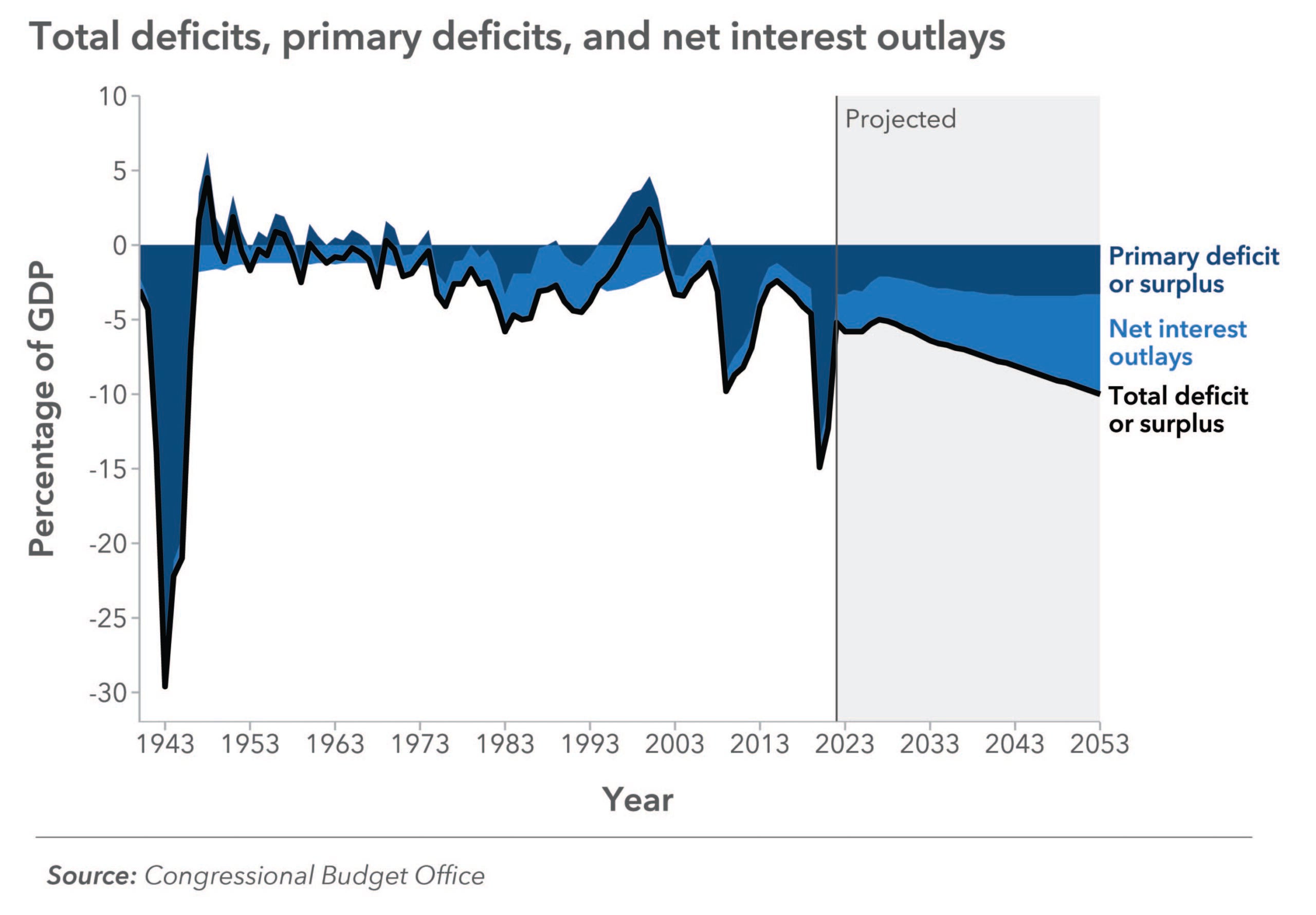
The outlook for federal debt represents a significant economic challenge for the United States. Economic developments and policy changes over the past two decades have materially raised the level of current and projected debt, but the primary factors behind the projected upward trajectory of debt remain population aging and rising health care spending. Even under optimistic economic scenarios, debt will soon reach levels well above historical experience, which will impose significant economic costs and risks. Although changes in policy that substantially narrow the deficit have economic and political disadvantages, they are necessary to put the federal budget on a sustainable path.

Suggested Citation: Dynan, Karen. November 8, 2023. “High and Rising US Federal Debt: Causes and Implications” In Building a More Resilient US Economy, edited by Melissa S. Kearney, Justin Schardin, and Luke Pardue. Washington, DC: Aspen Institute. https://doi.org/10.5281/zenodo.14019694.

Download (PDF)

Executive Summary

Introduction: Building a More Resilient US Economy

The post-pandemic US economy features a strong labor market but also persistent inflation, rising levels of debt, and acute educational challenges. These issues are compounded by ongoing, systemic difficulties: domestic and global, economic and political. This policy volume considers these topics and others, with a thematic focus on building a more resilient US economy.

The federal government’s aggressive fiscal and monetary policy in 2020 and 2021 mitigated the potential economic losses from the pandemic-induced recession and sped up economic recovery. However, trillions of dollars of federal assistance boosted aggregate demand in the face of constrained supply, spurring inflation to highs not seen since the 1980s. Restrictive monetary policy in the form of higher interest rates has helped tame inflation.

The overall response, however, has left the United States with a higher accumulated debt and larger deficits going forward. These results are compounded by more persistent factors, including the aging of the US population and rising health care costs, which drive up spending on major US entitlement programs including Social Security and Medicare.

After a long period of low interest rates led to some complacency about the US federal budget situation, current forecasts point again to at least somewhat higher interest rates that will make the continued imbalance between federal spending and revenues unsustainable. Building a more resilient US federal budget will require reforms that narrow the gap between spending and revenues, while maintaining sufficient levels of both to support national priorities. Accomplishing this task will require bipartisan cooperation and forward-looking congressional leadership.

The US labor market has remained strong in the post-pandemic period, but it shows signs of cooling and still faces long-term challenges that predate the pandemic. Despite widespread worries about women disproportionately falling out of the workforce during the pandemic, female rates of labor force participation and employment now exceed pre-pandemic levels (US Bureau of Labor Statistics (BLS) 2023a).

However, male labor-force participation and employment rates have recovered more slowly and remain depressed compared to prior decades: 86.4 percent of prime-age men in the US were employed in August 2023, equal to the 2019 average but below the 87.9 percent averaged in the 1990s (US Bureau of Labor Statistics 2023a, 2023b). As prime-age men work at lower rates, and as an aging population pushes a larger share of workers into retirement, the size of the workforce will start to grow much more slowly than it has in the past. Over the next ten years, the US labor force is forecast to add half the number of workers it added from 1990 to 1999 (Congressional Budget Office 2023a).

Building a more resilient US workforce will require promoting widespread employment and making investments in youth and young adults to build human capital and skills. It is troubling that the pandemic accelerated already-declining college enrollment: in 2022, there were over one million fewer students enrolled in college than there were in 2019 (National Student Clearinghouse 2023).

The pandemic disruption also led to large losses in student learning. Assessment data from 1.6 million elementary school students across more than 40 states indicate that in the spring of 2021, students were on average five months behind in mathematics and four months behind in reading progress compared to pre-pandemic cohorts. Learning losses were even larger for students in majority-Black schools and schools with lower average family income (Dorn et al. 2021). That study estimated that, if left in place, this learning loss could reduce lifetime earnings by $49,000 to $61,000 per student. Making up for these learning losses before they become permanent is an urgent priority, but doing so will not be easy.

Both the pandemic shock and recent geopolitical developments, including rising tensions with China and the war in Ukraine, have demonstrated the fragility of US supply chains and production. Businesses that lowered costs through just-in-time inventory practices, single-source suppliers, and manufacturing in countries with unstable political situations were left more vulnerable to supply shocks that fueled inflation. And heightened global tensions threaten the prospect of economic cooperation while creating political pressures at home for protectionist and nationalist policies.

The chapters in this book consider these and related issues.

Download (PDF)

Foreword: Building a More Resilient US Economy

The Aspen Economic Strategy Group’s sixth annual policy volume focuses on building a more resilient US economy.

Several major economic and geopolitical disruptions and developments in recent years—including the global COVID-19 pandemic, Russia’s invasion of Ukraine, and growing tensions with China—have heightened the need to get our domestic finances in order, strengthen supply chains, and build a strong domestic workforce.

How the United States navigates ongoing economic challenges in the coming years will have significant consequences for decades to come. Policymakers will need to make difficult spending and tax policy decisions to bring the US fiscal situation into better balance and to maintain our ability to invest in key priorities like national security, health care, and addressing climate change.

Given demographic and fiscal trends, to what extent will Medicare, Social Security, and other key safety net programs need to be reformed? How should the government raise more revenue to address the federal government’s fiscal imbalance? What are some priority investments that we need to make to ensure the future of the US economy?

This book examines these and related questions and offers evidence-based answers. Part I describes the long-term fiscal problems facing the US and considers challenges and solutions related to Social Security financing, prescription drug pricing, and reforming the US business tax code. Part II discusses the need for more widespread investments in youth, both immediately to rectify pandemic-induced learning loss and more generally as an investment in our nation’s future. Part III considers pressing global economic issues, including US efforts to strengthen its supply chains, as well as the current state of China’s economy and the factors that will determine its future trajectory.

Our annual policy volumes are intended to apply the best current economic research to help develop policy solutions to make the US economy work better for everyone. They do not represent the consensus view of the Aspen Economic Strategy Group’s members.

Download (PDF)

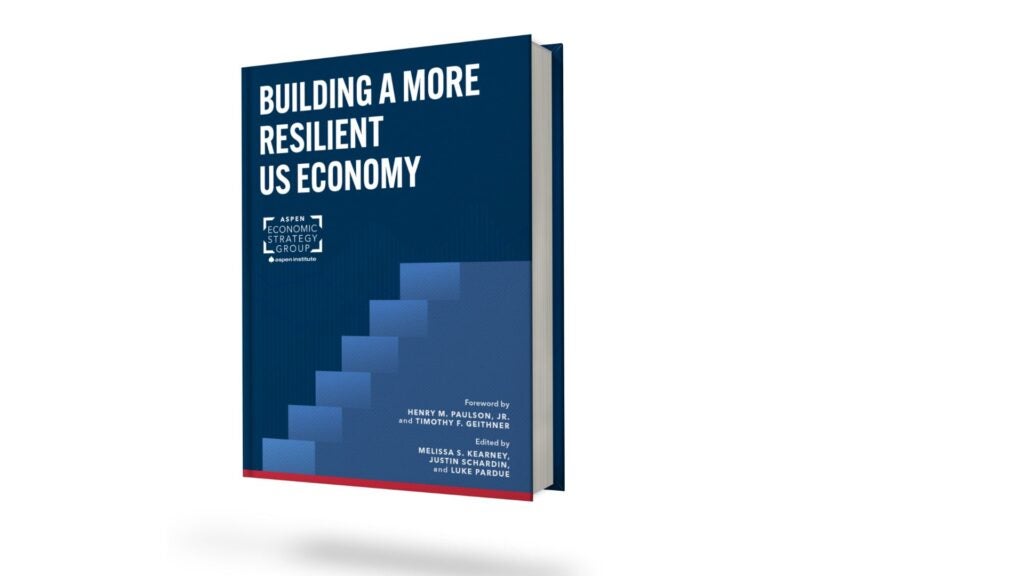
Book: Building a More Resilient US Economy

The Aspen Economic Strategy Group’s sixth annual policy volume, Building a More Resilient US Economy, considers some of the most pressing economic challenges facing the United States. The book’s publication comes as the US faces historically high levels of debt that threaten the resiliency of the nation’s economy, including the ability to invest in key priorities and adapt to changing global economic conditions. The book outlines a variety of evidence-based solutions to some of America’s biggest economic questions: Given demographic and fiscal trends, to what extent will Medicare, Social Security, and other key safety net programs need to be reformed? How should the government raise more revenue to address the federal government’s fiscal imbalance? What are priority investments that we should make to ensure the future workforce to grow the US economy?

DOWNLOAD BOOK (pdf)

  1. Foreword: Building a More Resilient US Economy
    by Henry M. Paulson, Jr. and Timothy F. Geithner
  2. Introduction: Building a More Resilient US Economy
    by Melissa S. Kearney, Luke Pardue, and Justin Schardin
  3. High and Rising US Federal Debt: Causes and Implications
    by Karen Dynan
  4. Reforming Social Security for the Long Haul
    by Mark Duggan
  5. Why Drug Pricing Reform is Complicated: A Primer and Policy Guide to Pharmaceutical Pricing in the US
    by Craig Garthwaite and Amanda Starc
  6. The Next Business Tax Regime: What Comes After the TCJA?
    by Owen Zidar and Eric Zwick
  7. Overcoming Pandemic-Induced Learning Loss
    by Jonathan Guryan and Jens Ludwig
  8. The Economic Case for Smart Investing in America’s Youth
    by Melissa S. Kearney and Luke Pardue
  9. Manufacturing Resilience: The US Drive to Reorder Global Supply Chains
    by Mary E. Lovely
  10. Where is China’s Economy Headed?
    by Hanming Fang