Key Takeaways From “The American Economy in a New Era”
Watch a recording of the event here.
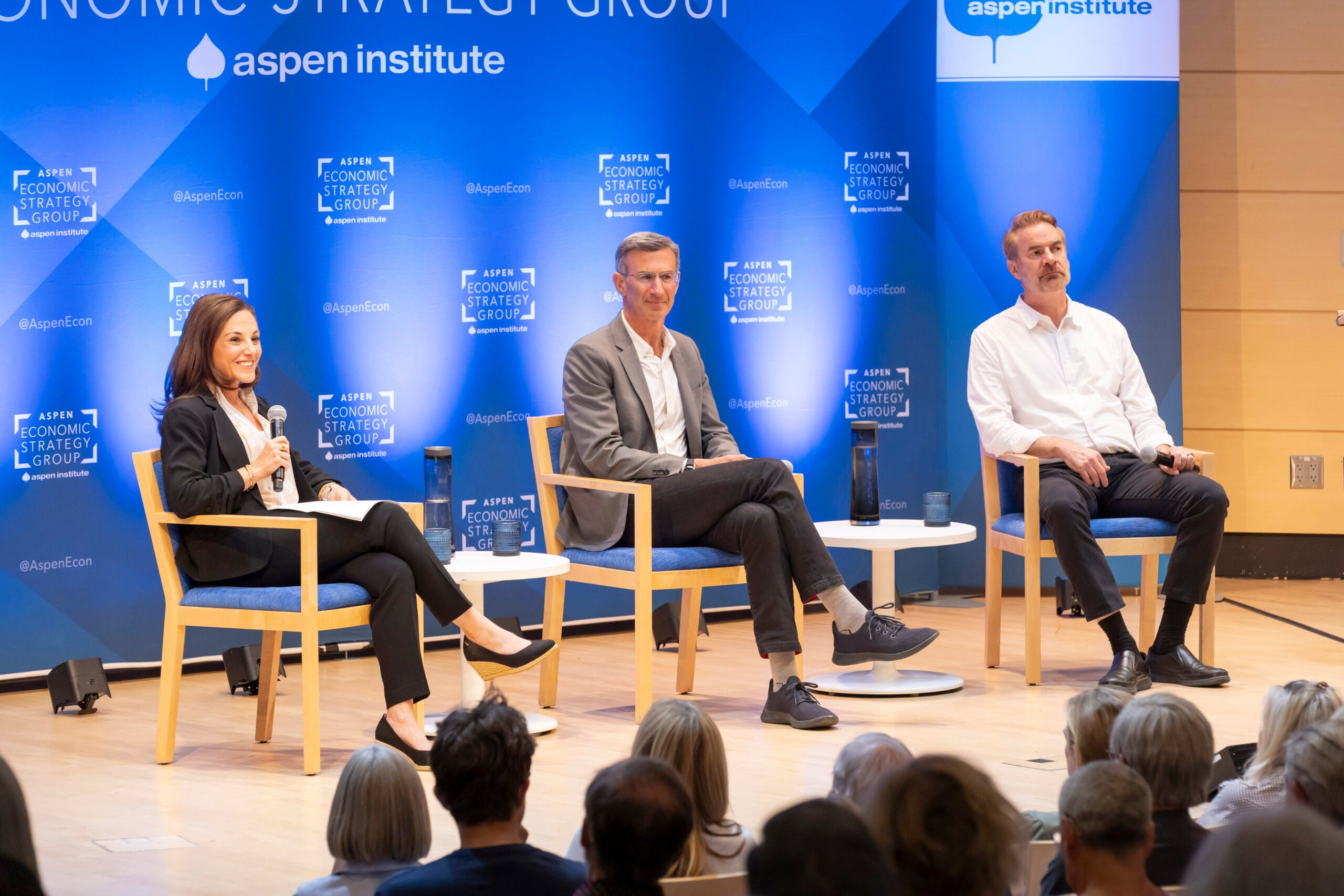
On August 5, 2026, the Aspen Economic Strategy Group (AESG) hosted The American Economy in a New Era featuring Stanford University economist Erik Brynjolfsson and Lazard CEO and Chairman Peter Orszag in conversation with AESG Director Melissa S. Kearney.
Opening the AESG’s sixth public program — held immediately following the group’s private annual meeting in Aspen, Colorado — Kearney noted that this year’s theme centered on perhaps the single most transformative force reshaping the American economy: artificial intelligence.
Kearney highlighted that perspectives on AI span a wide spectrum, with some developers forecasting miraculous advances in worker productivity and human flourishing, and others anticipating severe risks. To anchor the discussion, she asked Brynjolfsson and Orszag where their own outlooks fall along that continuum.
Brynjolfsson observed that despite remarkable strides in AI capabilities, key indicators — such as GDP, productivity growth, and employment — have yet to demonstrate significant movement. Brynjolfsson explained that this lag is a feature of the “productivity J-curve,” which posits that the effects of transformative new technologies can take time to appear in aggregate economic statistics as firms invest in the integration of such tools into business processes.
Furthermore, Brynjolfsson’s recent research suggests that the US economy is not facing an imminent “jobs apocalypse.” However, the data show early job losses among less experienced workers in sectors heavily exposed to AI. Orszag concurred that specific sectors of the economy are likely to face disruption, but noted that the technology is now mature enough to fundamentally transform workflows. The upside of these advancements, he suggested, is that younger workers will spend less time on monotonous, repetitive tasks, empowering them to advance within their organizations far faster.
Noting that public anxiety about AI is on the rise, Kearney asked the panelists how younger generations should prepare to participate in an AI-infused economy. Both emphasized that success will hinge on learning to ask the right questions, particularly as the technology becomes more adept at executing tasks. Additionally, Orszag highlighted that companies will place a growing premium on human-centric skills, favoring workers who excel at building relationships and instilling trust.
To ease this anxiety, Brynjolfsson outlined several proactive steps policymakers can take. Most crucial, he argued, is steering AI development to augment human capabilities rather than replace them entirely. He also urged policymakers to reimagine the tax code, wage insurance, and job training programs, while Orszag noted that lingering questions around the liability of AI companies’ use of training data will similarly demand a swift policy response.
Additionally, both Brynjolfsson and Orszag acknowledged that the US economy faces a growing risk of market concentration as a handful of dominant AI firms amass vast wealth and political influence — a trend already evidenced in the rise of “superstar” companies pulling far ahead of their competitors.
When asked whether AI development offers an opportunity for US-China collaboration, or whether the country finds itself in a zero-sum race, Orszag framed this dynamic as fundamentally competitive rather than collaborative, pointing to China’s desire to undermine the “underground empire” — the foundations of the global economy that largely run through US financial and technological infrastructure. Brynjolfsson agreed that the relationship is competitive and suggested that the best way forward is to accelerate technology adoption across domestic firms, reform immigration policy to attract global talent, and bolster international alliances.
To close the session, Kearney invited both panelists to share why they remain hopeful about the country’s economic future.
“Despite the fact that we’ve talked about a bunch of the risks, the fact of the matter is, if you look at a whole variety of indicators, this is still the country I would want my kids to grow up in, I would want to locate the majority of our business activity in, and that at the margin, I’d want to invest in,” Orszag affirmed.
Brynjolfsson concluded, “We need to worry about the economic and other concerns and work really, really hard to address them. If and only if we do that, then I think the next ten years will be arguably the best ten years in all of human history.”