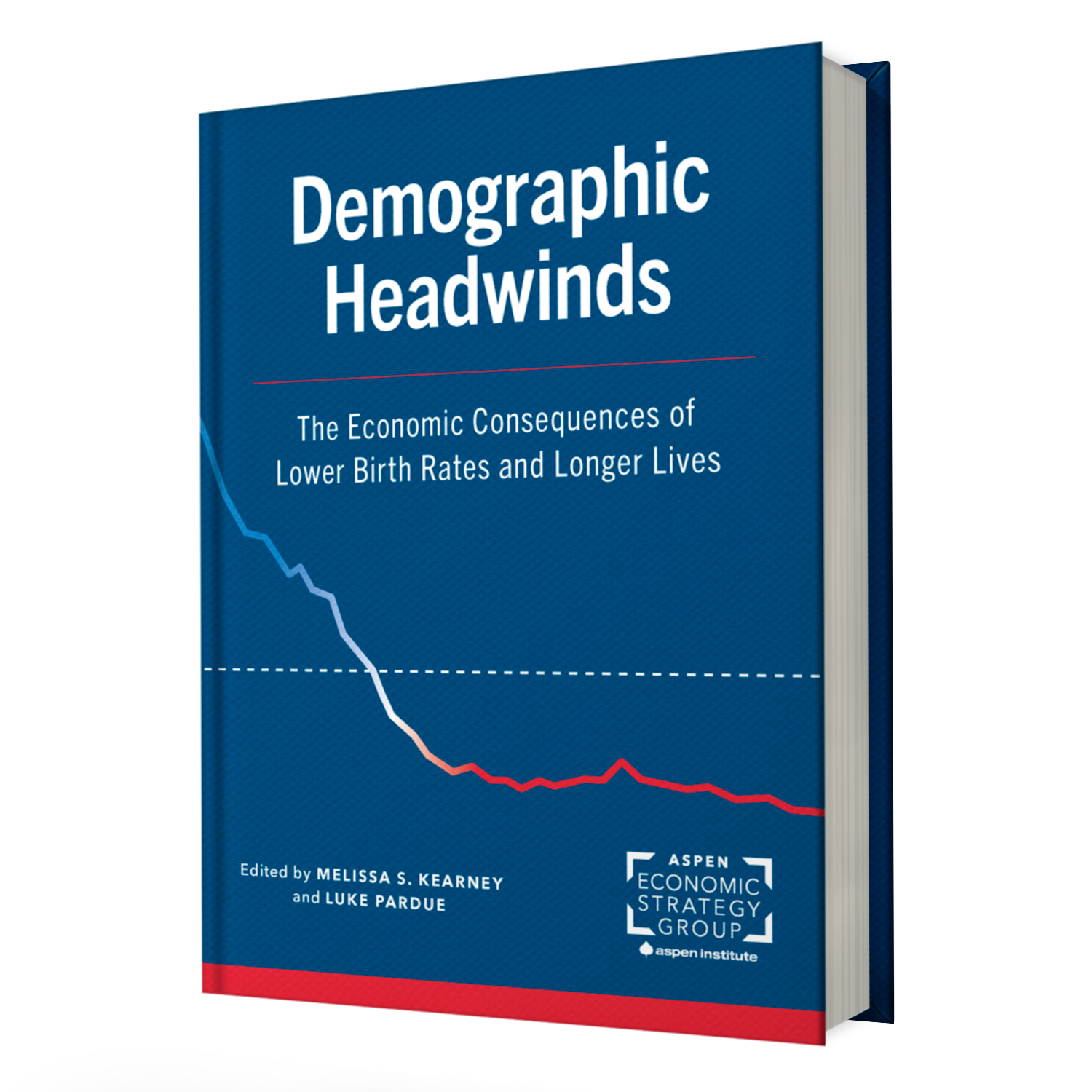
On Wednesday, March 18th, AESG Policy Director Luke Pardue testified at the Congressional Joint Economic Committee’s hearing, “Keeping Our Promises: Labor Inflows, Maintaining Competitiveness, and Supporting an Aging Population.” His written testimony is below. Watch the complete hearing here and see more information about the hearing here.
Chairman Schweikert, Ranking Member Hassan, and other members of the Joint Economic Committee, thank you for inviting me to participate in today’s hearing, “Keeping Our Promises: Labor Inflows, Maintaining Competitiveness, and Supporting an Aging Population.” I am a PhD Economist and the Policy Director of the Aspen Economic Strategy Group, which is committed to advancing bipartisan, evidence-based solutions to America’s greatest economic challenges. Our country’s current demographic challenges are among the most important long-term challenges we face; they have implications for labor market dynamism, economic growth, and the path of our public debt. My testimony today draws on my own research, as well as research we have commissioned and published at the Aspen Economic Strategy Group. Following my oral testimony, I would be happy to take questions.
I. Introduction – America’s Demographic Challenges
The United States is in the midst of a consequential demographic transition, marked by the dual trends of rising life expectancy and a sustained decline in the country’s birth rate.
Following the mid-twentieth-century Baby Boom and its subsequent reversal, the US total fertility rate – which is a constructed measure of the average number of children a woman will have over her lifetime based on current age-specific birth rates – remained roughly steady for several decades, hovering between 1.9 and 2.1. But that stability abruptly came to an end around 2007. Since then, birth rates have been on a downward trend, and the TFR fell from 2.12 in 2007 to a historic low of 1.63 in 2024. The fact that the US total fertility rate is now well below 2.1 has captured public attention, because 2.1 is the level of fertility at which a population replaces itself across generations.[1]
Meanwhile, the average lifespan in the US has steadily increased. A person born in the US in 1960 was expected to live to 70 years old, on average. By 2023, the average life expectancy had risen to 78.4 years.
As a consequence of declining birth rates and rising life expectancies, the share of the US population 65 or older has grown substantially, especially in recent decades. From 2005 to 2025, the share of the US population over age 65 increased from 12 to 18 percent (World Bank 2025).
These demographic shifts present substantial challenges to our country’s prosperity and our global economic competitiveness. In my testimony I would like to make three points:
First, the aging of the population is driving the rise in the federal government’s debt – and in turn reducing the capacity for other productive uses of spending. The aging of the large Baby Boom generation into retirement age has created a growing imbalance between spending on old-age entitlement programs such as Social Security and Medicare and the revenues needed to meet those obligations, leading to rising federal deficits. These deficits in turn leave less “fiscal space” for both economic emergencies and for other productive uses of public funds, including investment in future generations.
Second, this demographic shift has contributed to reduced American economic dynamism, lowering growth and diminishing the labor market prospects for younger workers. An innovative, dynamic business landscape drove the growth and prosperity that was a hallmark of the twentieth century US economy. Academic research has found that the aging of the US population is directly contributing to a decline in the rate of new business creation and firm growth. Today we are seeing job ladders “congested” by older workers remaining in their roles longer and a lack of new opportunities for young workers to step into.
Third, there are a menu of options available to policymakers to address these challenges. We should bring our high skill immigration system in line with the needs of our modern economy to attract the global talent that has historically driven innovation, entrepreneurship, and global competitiveness. We should invest in our domestic workforce, from childhood to young adulthood, to raise skilled, productive adults who can meet the needs of the global economy. And we should take steps to address a significant driver of these long-term demographic trends: America’s declining birth rate.
II. America’s Aging Population and Fiscal Position
The country’s demographic trends have shaped the US federal government’s spending and revenue patterns, driving the large and growing federal debt. From 1960 through 2000, federal debt as a share of GDP hovered between 25 and 50 percent of GDP. In the middle of the first decade of the 2000s, the federal debt began to steadily climb, reaching 75 percent of GDP around 2015 and nearly 100 percent of GDP in 2024. In the long-run budget projections produced by the Congressional Budget Office (CBO 2025), federal debt will continue to grow as a share of GDP over the next thirty years, reaching over 150 percent by 2055.[2]
- The rise in spending on old-age entitlement programs over the past several decades has been a major contributor to the rise of primary budget deficits.
Demographic shifts affect the federal budget primarily because they affect the ratio of dependents, both children and the elderly, to the working-age population. Old-age dependency ratios are particularly important to understanding the rise in deficits and the federal debt over the past three decades – both because of the size of the cohorts entering retirement and the amount we spend on the elderly, reflecting for the most part the major old-age entitlement programs, Social Security and Medicare.
As America’s population has aged, spending on such programs has consumed a greater share of public resources. In the mid-1960s, spending on old-age entitlement programs was 2.5 percent of GDP. Since then, it has steadily risen to about 6 percent of GDP in 2000 and to almost 9 percent of GDP in 2023.[3] All else equal, if these programs had remained at their 2000 level as a share of GDP, the primary deficit in 2023 would have been about 0.8 percent of GDP, compared to 3.3 percent of GDP (Dettling and Pardue 2026).
- The continued aging of the country’s population is driving the projected increase in the US budget deficit over the next 30 years.
Spending on the major old-age entitlement programs is also projected to continue to grow relative to GDP and is a key contributor to further rising deficits and debt. This is because the still relatively large cohorts born just after the baby boom in 1960–1970 are expected to enter retirement at that time.[4] If old-age dependency ratios were to remain at their 2024 level throughout our projection, old-age entitlement program spending would grow much more slowly, reaching only 9.8 percent of GDP in 2055 instead of 12.6 percent.
Indeed, without the growth in old-age entitlement program spending due to rising old-age dependency ratios, deficits would fall substantially over the next 30 years. Around 2040, the government would begin operating under a primary budget surplus if it were not for the growth in such spending. With a budget surplus, the federal debt would begin to fall, net interest payments would be smaller, and total deficits would shrink.
- This rising debt is crowding out other productive uses of public funds
The rising debt presents many concerns, but I would like to highlight one here: higher debt reduces the country’s “fiscal space,” meaning its capacity to raise the deficit in the case of an economic emergency or to support other domestic needs without the possibility endangering access to financial markets (Dynan 2023).
One relevant example is that in 2019, for every dollar the federal government spent per child on programs benefitting children, it spent $5 per elderly American – just considering old-age entitlement programs alone (Kearney and Pardue 2023). By 2023, the federal government spent more on interest on the federal debt than it spent on children, which often generate large, long-run social returns (Hahn et al 2024).
III. Business Dynamism, the US Labor Market, and the Aging Population
Second, demographic shifts are also reshaping the U.S. labor market, slowing the business dynamism that has been a hallmark of the US economy since the middle of the twentieth century and hampering the career prospects of younger workers.
- Absent other changes, a slower-growing and eventually declining working-age population will hamper business dynamism, dampen productivity growth, and slow the rise of Americans’ living standards.
The United States has among the most dynamic and flexible economies in the world, allowing us to adapt to changing economic circumstances and recover from recessions.[5] Yet, we have seen a dramatic decline in key measures of business dynamism over the last four decades: between 1979 and 2023 the share of new employers as a fraction of all firms– what we call the startup rate – has fallen by 29 percent. At the same time economic activity is increasingly concentrated at large and mature firms (Decker et al 2014).
Recent research finds that the demographic shifts I have described are driving a substantial portion of this decline in dynamism: the slowdown in the growth of the working-age population, driven by end of the Baby Boom, can account for one third of the decline in the startup rate (Karahan et al. 2024).
This decline in business dynamism comes with real economic consequences. It has been linked to the drop in the share of income going to labor (Glover and Short 2018); it can account for the emergence of “jobless recoveries” (Pugsley and Şahin 2019); and, perhaps most importantly, the demographic-driven decline in firm entry has been linked to the long-term slowdown of aggregate productivity growth: between 1980 and 2014, this “startup deficit” dragged aggregate productivity down by 3.1 percent (Alon et al. 2018). The authors of that research calculated that, in 2014 alone, real median household income would have been roughly $1,600 higher had the startup deficit never occurred, with of course magnitudes larger effects over the entire 35-year period.
- Amid this decline in business dynamism and the aging of the workforce, “congestion effects” in the workplace are slowing down younger workers’ career trajectories.
Finally, I would like to shed light on one more consequence of these trends: the aging of the workforce amid declining business dynamism is slowing the career progression of younger workers.
Longer life expectancy and improvements in health care have contributed to an increase in the number of older workers who postpone retirement and remain active in the labor market. While this trend may benefit firms and older workers themselves, it has created challenges for younger workers, since it can also generate “congestion effects” that slow their own advancement up the career track (Bianchi and Paradisi 2026). As older employees remain in high-paying managerial roles longer, younger workers face fewer opportunities to move into such jobs and experience slower professional advancement during early stages of their career. When fewer new firms are created and existing firms age, there are fewer expanding businesses, and hence fewer newly created positions, to relieve this congestion in firms’ hierarchies created by an older workforce. The result is that younger workers face delayed progression, slower wage growth, and fewer chances to reach the top.
We have seen these dynamics play out in the United States amid the domestic retirement slowdown: looking between 1980 and 2017, research has found that, in US commuting zones where older workers delayed retirement, job opportunities shifted away from high-skill occupations and toward low-skill work. In these communities, younger workers with a college degree took jobs that often did not require a college education, and they earned lower wages than similar workers in areas that did not experience as great of a retirement slowdown (Mohnen 2025).
These congestion effects created by workforce aging are shaping key life choices and amplifying intergenerational inequalities by creating uncertainty about future earnings growth that make it harder for younger generations to buy homes, invest in education, and start a family during these prime years.
To be sure, this development might be in firms’ short-term interests, and it is certainly a good thing that people are living longer lives and are able to productively engage in work longer. However, it does present a real challenge about how to ensure young adults have opportunities to advance in their careers and develop leadership skills. It would serve our economy and society well if this challenge were acknowledged and addressed head on.
IV. Evidence-based paths to addressing these challenges
Absent policy action, these trends paint a picture of America moving into the remainder of the 21st century with an older, slower growing – and should trends persist, shrinking – population. Left unaddressed, they point to a future where federal programs aimed at providing income security and medical care for the aging population consume an ever-greater share of our public resources, driving deficits and debt higher; where reduced business dynamism leaves younger workers without the skills and the opportunities they need to thrive; and where America is at a competitive disadvantage in the global economy.
Thankfully, rigorous research backs up the idea that this does not need to be our future. I highlight three important steps policymakers can take to address these challenges:
- Reversing America’s declining birth rate may not meaningfully improve macroeconomic outcomes for decades, but we should still take steps to raise or stabilize the birth rate by supporting people who want to have children.
We can be sober-minded about the timeline over which changes in America’s birth rate can meaningfully affect population trends – and thus macroeconomic outcomes – while at the same affirmatively aiming to at least stabilize, if not reverse, its decades-long decline. In my work with Lisa Dettling, we find that even if fertility trends reversed beginning in 2026, deficits would not begin to improve for roughly 20 years – when the new cohorts entered the workforce – and until then, deficits would worsen as a result of public spending associated with children (Dettling and Pardue 2026).
However, a declining birth rate and a shrinking population brings significant challenges, as noted above. And, I would like to note, the potential environmental benefits of declining birth rates are often wildly exaggerated. Simply put, a change in births today will not meaningfully affect global emissions or the earth’s temperature over the next century, well before action may be required. Moreover, there is good reason to believe that our ability to discover and implement solutions to such challenges is greater in a world with more people, rather than fewer (Kuruc 2026).
Evidence suggests that there are ways to relax existing constraints and raise birth rates by making it easier for people who want to have children to feel like they can afford to. (See Kearney and Levine (2026) for an extensive review of this evidence.) Though incremental policy changes like modest tax credits and paid leave expansions have proven not to have large impacts on birth rates, small changes compounded over time can potentially lead to millions more people in this country (Stone 2025).
Furthermore, there is evidence suggesting that making it easier for young families to enter into home ownership might lead to meaningful increases in births. Looking back to the Baby Boom, the increased affordability and accessibility of single-family homes to young families through the introduction of low-down payment, fixed interest rate, long-term mortgages was responsible for about 10 percent of the increase in births (Dettling and Kearney 2025). In general, to reverse the decline in birth rates, we should enact policies that make raising a family more affordable and accessible to young adults today.
- We should treat high-skilled immigration as a key policy lever in our global economic competitiveness toolkit
In the near-term, we can create new opportunities for American workers, ease our fiscal strains, and meet America’s ambition for global economic leadership in this new era by improving our ability to attract and retain the world’s brightest minds.
High skilled immigrants – specifically, those holding STEM degrees – generate greater economic opportunities for the native-born population in several ways. They create scientific and technological innovations that raise productivity and boost wages of native-born workers (Peri et al 2015). They start new businesses in the US that then hire American workers. Indeed, after taking this business creation margin into account, immigrants act as net job creators in the United States (Azoulay et al 2020). They also make American entrepreneurs more successful: startups with founding teams made up of native-born Americans and immigrants have 23 percent more employees after three years than startups with only native-born founders (Jin et al 2025).
High skill immigrants also ease America’s public debt burden. A recent analysis by the Penn-Wharton Budget Model found that, keeping total immigration the same but shifting 10 percent of the visas awarded towards STEM graduates would reduce our budget deficit by $153 billion over ten years (Mazin and Reichling 2025).
To be sure, in our current era, when the connection between America’s technological leadership, national security, and economic power has rarely been stronger, attracting the best and brightest from around the world is not simply good policy but should be a national imperative. High skilled immigration is a tool that can generate economic growth and dynamism at any time, but right now it is a key policy lever in our strategic competitiveness toolkit, and it should be treated as such.
Yet today, the rules that govern our high-skilled immigration system are increasingly misaligned with the needs of the modern global economy. Green card limits set in the 1990s have resulted in wait times in some cases on the order of decades. Temporary visas have become the de facto talent recruitment system and annual renewal has become the standard retention system. And our system of selection relies on random lottery and first-come-first-serve rules rather than a comprehensive talent selection strategy (Neufeld 2025).
- Finally, investing in our future generations, from childhood through young adulthood, will create more skilled, productive workers and citizens.
A complimentary approach to that described above – raising the US birth rate or increasing high-skilled immigration – is to create a more productive population.
We can do that first by investing in children. Rigorous research has found that specific types of spending on children raise their educational attainment, earnings, and health in adulthood, often saving government funds in the long run as the higher earnings and improved health result in greater tax revenue and less reliance on government programs later in life (Pardue and Kearney 2023).
We also need to bolster our efforts to help adult workers navigate labor market disruptions. Fortunately, we have begun to see examples of worker training programs that produce positive results, and we must find ways to scale these programs to reach more workers. Sectoral Employment Programs, an example of “demand-driven” models of worker training that feature strong connections to local employers and target occupations in high-wage sectors, have been found to be particularly effective. (See Katz et al. 2022 for a discussion of these programs and the features that may lead to greater effectiveness.)
More broadly, we must think seriously now about how to improve our country’s education and labor market institutions, equipping workers with skills that allow them to be flexible and resilient in the face of a rapidly evolving economy.
Thank you again for the opportunity to testify. I look forward to taking your questions.
References
Azoulay, Pierre, Benjamin F. Jones, J. Daniel Kim, and Javier Miranda. 2022. “Immigration and Entrepreneurship in the United States.” American Economic Review: Insights 4 (1): 71–88.
Bartelsman, Eric, John Haltiwanger, and Stefano Scarpetta. 2013. “Cross-Country Differences in Productivity: The Role of Allocation and Selection.” American Economic Review 103 (1): 305–34.
Bianchi, Nicola and Matteo Paradisi. 2024. “Countries for Old Men: An Analysis of the Age Pay Gap,” NBER Working Paper 32340. https://doi.org/10.3386/w32340.
Bianchi, Nicola and Matteo Paradisi. 2026. “The Age Divide in the American Workplace” In Demographic Headwinds: The Economic Consequences of Lower Birth Rates and Longer Lives, edited by Melissa S. Kearney and Luke Pardue. Washington, DC: Aspen Institute. https://www.economicstrategygroup.org/publication/bianchi-paradisi-workplace/.
Congressional Budget Office (CBO). 2025b, March 27. The Long-Term Budget Outlook: 2025 to 2055. Publication no. 61187. CBO. https://www.cbo.gov/publication/61187.
Decker, Ryan, John Haltiwanger, Ron Jarmin, and Javier Miranda. 2014. “The Role of Entrepreneurship in US Job Creation and Economic Dynamism,” The Journal of Economic Perspectives, 28(3): 3–24.
Dettling, Lisa and Kearney, Melissa. 2025. “Did the Modern Mortgage Set the Stage for the U.S. Baby Boom?” NBER Working Paper 33446. https://www.nber.org/papers/w33446
Dettling, Lisa and Luke Pardue. 2026. “Low Fertility and Fiscal Sustainability: The Effects of Past and Future Fertility Rates on the US Federal Budget Outlook.” In Demographic Headwinds: The Economic Consequences of Lower Birth Rates and Longer Lives, edited by Melissa S. Kearney and Luke Pardue. Washington, DC: Aspen Institute. https://www.economicstrategygroup.org/publication/pardue-dettling-budget/
Dynan, Karen. 20223. “High and Rising US Federal Debt: Causes and Implications” In Building a More Resilient US Economy, edited by Melissa S. Kearney, Justin Schardin, and Luke Pardue. Washington, DC: Aspen Institute. https://doi.org/10.5281/zenodo.14019694.
Foster, Lucia, Cheryl Grim, and John Haltiwanger. 2016. “Reallocation in the Great Recession: Cleansing or Not?,” Journal of Labor Economics. 34(1).
Furman, Jason., 2024. “Eight Questions—and Some Answers—on the US Fiscal Situation” In Strengthening America’s Economic Dynamism, edited by Melissa S. Kearney and Luke Pardue. Washington, DC: Aspen Institute. https://doi.org/10.5281/zenodo.14036808.
Glover, Andrew and Jacob Short. 2020. “Demographic Origins of the Decline in Labor’s Share.” BIS Working Paper 874. https://www.bis.org/publ/work874.pdf
Hahn, Heather, Elli Nikolopoulos, Cary Lou, Hannah Sumiko Daly, Eden Phillips, Michelle Casas, C. Eugene Steuerle. 2024. “Kids’ Share 2024.” Urban Institute. Accessed 15 March 2026. https://www.urban.org/research/publication/kids-share-2024
Jin, Zhao, Amir Kermani, and Timothy McQuade. 2025. “Native-Immigrant Entrepreneurial Synergies,” NBER Working Paper 33804. https://doi.org/10.3386/w33804.
Karahan, Fatih, Benjamin Pugsley, and Ayşegül Şahin. 2024. “Demographic Origins of the Start-up Deficit.” American Economic Review 114 (7): 1986–2023.
Katz, Lawrence, Jonathan Roth, Richard Hendra, and Kelsey Schaberg. 2022. “Why Do Sectoral Employment Programs Work? Lessons from WorkAdvance,” Journal of Labor Economics. 40(1).
Kearney, Melissa S. and Phillip B. Levine. 2022. “The Causes and Consequences of Declining US Fertility” In Economic Policy in a More Uncertain World, edited by Melissa S. Kearney and Amy Ganz. Washington, DC: Aspen Institute. https://doi.org/10.5281/zenodo.14025899.
Kearney, Melissa S. and Phillip B. Levine. 2025. “Why Is Fertility So Low in High Income Countries?” NBER Working Paper 33989. https://www.nber.org/papers/w33989
Kearney, Melissa and Luke Pardue. 2023. “The Economic Case for Smart Investments in America’s Youth.” In Building a More Resilient US Economy, edited by Melissa S. Kearney, Justin Schardin, and Luke Pardue. Washington, DC: Aspen Institute. https://www.economicstrategygroup.org/publication/the-economic-case-for-smart-investing-in-americas-youth/
Kuruc, Kevin. 2026. “The Environmental Benefits of Low Fertility and Population Decline are Overstated” In Demographic Headwinds: The Economic Consequences of Lower Birth Rates and Longer Lives, edited by Melissa S. Kearney and Luke Pardue. Washington, DC: Aspen Institute. https://www.economicstrategygroup.org/publication/kuruc-environment/.
Mohnen, Paul. 2025. “The Impact of the Retirement Slowdown on the US Youth Labor Market.” Journal of Labor Economics. 43(1). https://doi.org/10.1086/725874
Neufeld, Jeremy. 2025. “Aligning High-Skilled Immigration Policy with National Strategy.” In Advancing America’s Prosperity, edited by Melissa S. Kearney and Luke Pardue. Washington, DC: Aspen Institute. https://www.economicstrategygroup.org/publication/neufeld-immigration/
Peri, Giovanni, Kevin Shih, and Chad Sparber. 2015. “STEM Workers, H-1B Visas, and Productivity in US Cities.” Journal of Labor Economics. 23(33). https://doi.org/10.1086/679061
Pugsley, Benjamin Wild, and Ayşegül Şahin. 2019. “Grown-up Business Cycles.” The Review of Financial Studies 32(3): 1102–47. https://www.jstor.org/stable/48616820.
Ruiz Mazin, Felipe and Felix Reichling. 2025. “Shifting Immigration Toward High-Skilled Workers.” Penn-Wharton Budget Model. Accessed 15 March 2026. https://budgetmodel.wharton.upenn.edu/p/2025-03-24-shifting-immigration-toward-high-skilled-workers/
Stone, Lyman .2025. “Lyman Stone on Demographic and Marriage Decline.” MacroMusings Podcasts. Mercatus Center. Accessed 15 March 2026. https://www.mercatus.org/macro-musings/lyman-stone-demographic-and-marriage-decline
U.S. Centers for Disease Control and Prevention. “Table 1-7. Total Fertility Rates and Birth Rates, by Age of Mother and Race of Child: United States, 1940-80.” Accessed 15 March 2026. “https://archive.cdc.gov/www_cdc_gov/nchs/data/statab/tab1x07p.pdf
World Bank. 2025. Population Ages 65 and Above for the United States (SPPOP65UPTOZSUSA). Retrieved via FRED, Federal Reserve Bank of St. Louis. https://fred.stlouisfed.org/series/SPPOP65UPTOZSUSA.
[1] Similar patterns are seen in the US general fertility rate, a point-in-time measure of fertility, which held roughly steady for several decades after the end of the Baby Boom at around 65 to 71 births per 1,000 women of childbearing age, before falling to a historic low of 54.6 in 2023.
[2] See Dettling and Pardue (2026) for a discussion of the evidence regarding the level of debt that is sustainable for the United States to maintain or accumulate.
[3] Federal spending on children, on the other hand, accounted for about 2 percent of GDP in 2023 (Dettling and Pardue 2026).
[4] TFR averaged 3.0 from 1960–1970 (CDC n.d.).
[5] For a discussion of business dynamics in the US in an international comparison and its role during recessions, see Bartlesman, Haltiwanger, and Scarpetta (2013), Foster, Grim, and Haltiwanger (2013), Pugsley and Şahin (2019).