Aligning High-Skilled Immigration Policy with National Strategy

The United States’ innovative edge depends on its ability to draw on the best talent from around the world. However, the laws that govern high-skilled immigration are outdated and misaligned with the needs of today’s economy. Only a small share of green cards, which provide immigrants permanent resident status in the United States, are allocated based on skills or employment. These eligibility pathways are constrained by rigid numerical caps, causing long and growing backlogs. As a result, temporary visas (such as H-1Bs and J-1s) have become the de facto system for recruiting and retaining high-skilled workers in the US, even though these pathways are not designed to provide long-term employment or residency. Moreover, these temporary visas are also subject to restrictive caps and allocation mechanisms that undermine strategic selection.
In Aligning High-Skilled Immigration Policy with National Strategy, Jeremy Neufeld outlines the shortcomings of the current high-skill immigration system and offers policy reforms that would advance the United States’s ability to attract, select, and retain the world’s most promising workers.
Green-card caps and per-country limits restrict the flow of high-skilled talent.
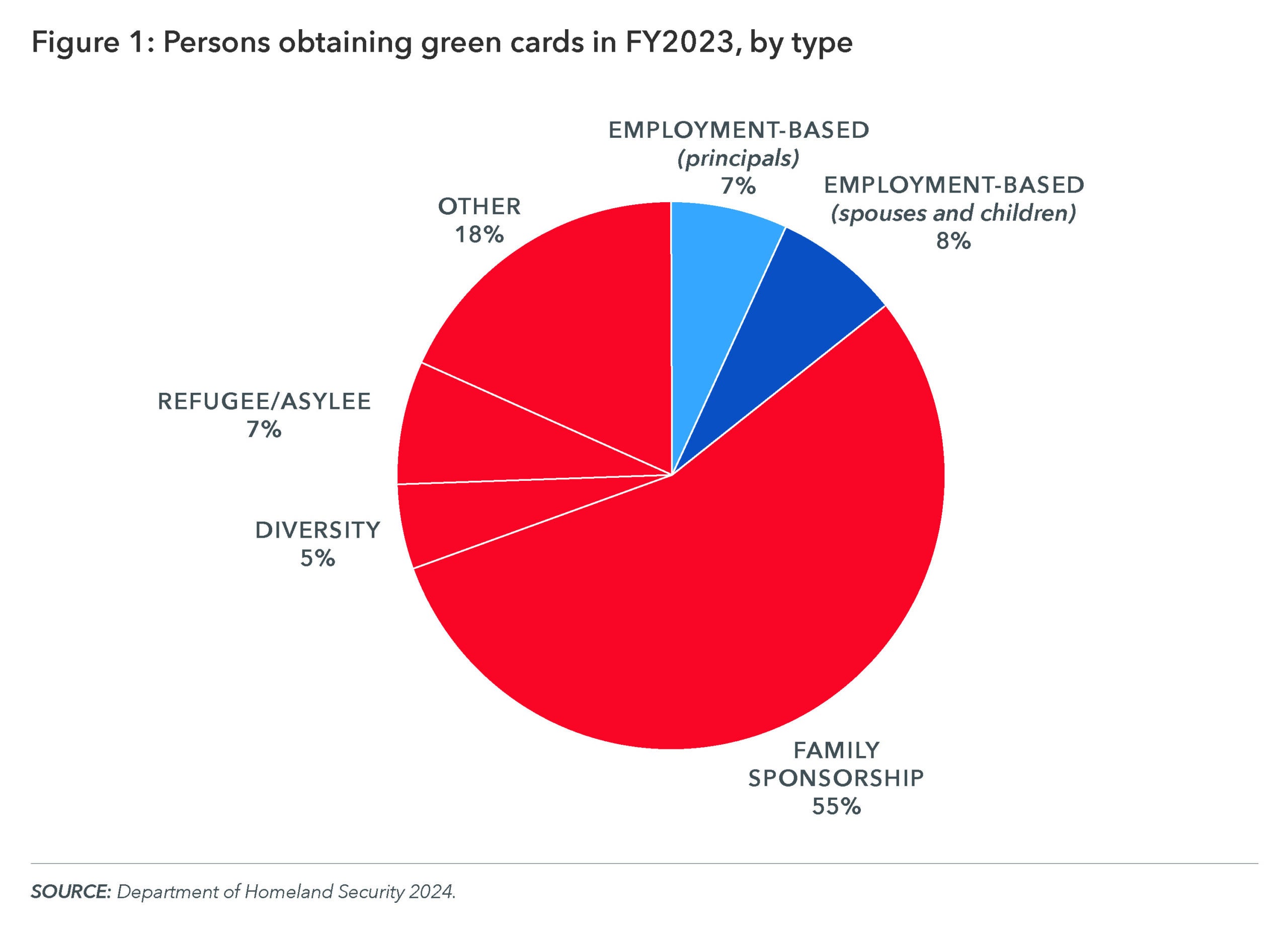
Each year, the US issues about one million green cards, which offer lawful permanent resident status, but only 7 percent go to individuals selected on the basis of their skills or job offers. These limits—set more than three decades ago—are compounded by per-country caps that can produce decades-long wait times. To address these issues, Neufeld proposes that Congress increase the number of green cards available for high-skilled workers, particularly in critical emerging-technology fields.
Temporary visa programs create bottlenecks and reduce selectivity.
U.S. recruitment of high-skilled workers relies heavily on temporary nonimmigrant visas such as F-1 student visas and H-1B specialty occupation visas, which are limited in duration and tightly constrained by employment rules. This “funnel” system accepts far more recruits at the top, through universities and exchange programs, than there are available green cards at the bottom. To strengthen selection and efficiency, Neufeld recommends replacing the random H-1B lottery with a compensation-based allocation system that prioritizes the most qualified candidates.
Rigid visa rules limit innovation and fail to prioritize merit.
Visa holders are often tied to specific employers and have stringent, work-related restrictions, significantly limiting the labor market mobility of the visa holder. This rigidity significantly restricts innovation and entrepreneurship, preventing immigrants from starting their own companies or commercializing research for fear of losing their visa, and in turn limiting innovation spillovers that would otherwise benefit the broader economy.
Neufeld proposes a points-based green-card system that awards visas based on characteristics associated with success, like education, SAT scores, salary, language proficiency, and job offers. Furthermore, he also recommends more proactive talent recruitment, as existed during the end of World War II. He suggests that talent scouts could experiment with identifying and recruiting to the United States winners of math and science olympiads, winners of scientific prizes, budding entrepreneurs, and top young scientists, in order to attract the highest potential immigrants.
Suggested Citation: Neufeld, Jeremy., 2025. “Aligning High-Skilled Immigration Policy with National Strategy.” In Advancing America’s Prosperity, edited by Melissa S. Kearney and Luke Pardue. Washington, DC: Aspen Institute. http://dx.doi.org/10.2139/ssrn.6506882.